Introduction to the study of organic chemistry : the chemistry of carbon and its compounds / by Henry E. Armstrong.
- Henry Edward Armstrong
- Date:
- 1890
Licence: Public Domain Mark
Credit: Introduction to the study of organic chemistry : the chemistry of carbon and its compounds / by Henry E. Armstrong. Source: Wellcome Collection.
355/378 (page 333)
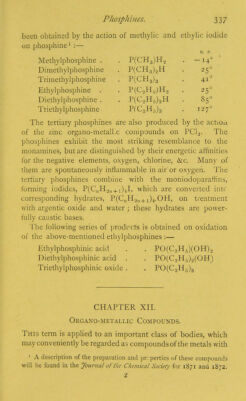
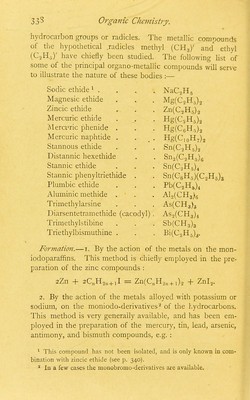
![amine was originally obtained by distillation of indigo with potassic hydrate ; the botanical name of the indigo plant being Indigo/era anil, it therefore was termed aniline. It has of late years attained to great importance on account of the numerous and magnificent dyes derived from it, and is prepared on the large scale by the reduction of nitrobenzene by iron and acetic acid. Aniline is a colourless oily liquid of peculiar odour at ordinary temperatures, but at - 8° solidifies to a crystalline mass; it boils at 182°; it is only slightly soluble in water. By the action of ethylic iodide it may be converted successively into ethylphenyl-, diethylphenyl-, and triethylpbenyl-ammonic iodide. From the two former ethyl- and diethyl-phenyl- amine may be separated by potassic hydrate ; the latter is con- verted into triethylphenylammonic hydrate on treatment with argentic oxide and water. Aniline forms with the various acids well-crystallised salts ; similarly, mono- and di-bromaniline are basic compounds and form salts, but the salts of dibromaniline are far less stable than the corresponding salts of bromaniline. The introduction of a third unit of bromine in place of hy- drogen reduces the amine to a neutral body: tribromaniline, N(C6H2Br3)H2, being incapable of forming salts. Action of Citrous Acid on the Primary Monamines.—The mon- amines of the series N(C„H2n+1)H2 are converted into corre- sponding monohydric alcohols by the action of nitrous acid : The monamines derived from the hydrocarbons of the CnH2n_6 series and isologous series containing proportionately less hy- drogen may also be ultimately converted into corresponding al- cohols, aniline, for example, yielding phenol; but in the majority of cases an intermediate product—a so-called diazo-derivative— may be isolated ; if a salt of the monamine be acted upon, a diazo-salt is produced, e.g. : CnH2n+1.NH,(HNO.,) = CnH nn2n+i .OH + N2 + OH,. ( C6H5 Nv] H3 + HNO ((NO,)' ( 2 Aniline nitrate. Diazobenzene nitrate. or generally : NR'H3(N03) + HN02 = NR'N'(N03) + 20H2.](https://iiif.wellcomecollection.org/image/b21499445_0355.jp2/full/800%2C/0/default.jpg)