On fractures and dislocations / by Professor Dr. H. Helferich ; ill. with 68 plates and 126 figures in the text, drawn by B. Keilitz ; tr. from the 3d ed. (1897) with notes and additional illustrations, by J. Hutchinson.
- Heinrich Helferich
- Date:
- 1899
Licence: Public Domain Mark
Credit: On fractures and dislocations / by Professor Dr. H. Helferich ; ill. with 68 plates and 126 figures in the text, drawn by B. Keilitz ; tr. from the 3d ed. (1897) with notes and additional illustrations, by J. Hutchinson. Source: Wellcome Collection.
Provider: This material has been provided by the Francis A. Countway Library of Medicine, through the Medical Heritage Library. The original may be consulted at the Francis A. Countway Library of Medicine, Harvard Medical School.
394/440 page 144
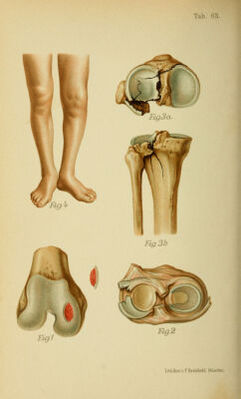
![B. InjurII to the, semilunar cartilages (Plate LXIII, fig. 2). —Under this heading come dislocation and rupture of the semilunar cai'tilages, which accidents may occur as indepen- dent injuries. In 1892 Bruns was able to collect forty-three cases. The internal semilunar cartilage is concerned twice as often as the external one ; usually the attachment of its anterior end is torn, but the cartilage is very rarely completely detached or divided in its continuity. In the production of this accident strong rotation of the lower end of the femur when the knee- joint is bent usually occurs, and it is exceptional for it to happen in a perfectly sound normal joint; for this reason the injury is most frequently observed in England among foot- ball players and the like.^ Syinjjtoins vary in intensity, but there is always marked pain felt on pressure on the side of the joint concerned. 'Ihe latter is slightly flexed and cannot be fully extended, and there is effusion into it. In cases where the displacement has occurred over and over again, the pain and impaired mobility become lessened in degree. Objective examination frequently reveals a flat moveable body, which during extension projects at the fore part of the inter line and in flexion disappears. As it moves forwards and backwards a sort of snap may be felt by both surgeon and patient. When the detached end of the semilunar cartilage remains in the centre of the joint the inter line may simply be more hollowed and painful to pressure than normal, but if there is much effusion the diagnosis may be impossible, and it is generally very difficult, from the cases of loose cartilage (foreign body). Treatment.—In recent cases reposition and moderate pressure, and later the use of ])laster-of-Paris bandage in extension, with subsequently the continued use of a light 1 In violent ilexion ot the knee-joint tlie (-'orce exerted tlirongh one of tlie crucial li.L^ainents may tear off a piece of bone from either the tibia or tlie femur. In a remarkable case recorded by Mr. Erichsen a boy fell a considerable distance with both knees flexed. At the post-mortem it was found that on one side the anterior crucial ligament hod torn away part of the tibia, on the other side its attachment to the femur, i.e. pait of the externnl condyle. In such cases there is sure to be much effusion of blood into the knee-joint, with probably much impairment of mobility.—J, H.](https://iiif.wellcomecollection.org/image/b21057989_0394.jp2/full/800%2C/0/default.jpg)