[Report 1951] / School Medical Officer of Health, Salop / Shropshire County Council.
- Shropshire (England). County Council.
- Date:
- 1951
Licence: Attribution 4.0 International (CC BY 4.0)
Credit: [Report 1951] / School Medical Officer of Health, Salop / Shropshire County Council. Source: Wellcome Collection.
15/38 (page 13)
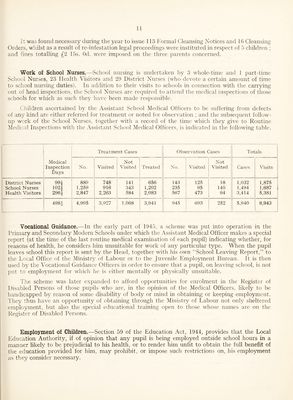
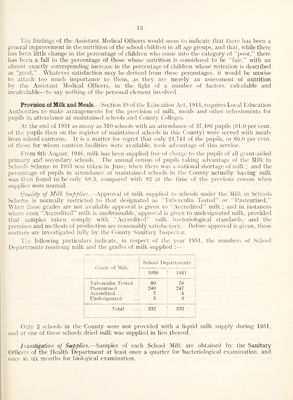
![The findings of the Assistant Medical Officers would seem to indicate that tiicre has been a general improvement in the nutrition of the school children in all age groups, and that, while there has been little change in tlie percentage of children who come into the category of poor,” there has been a fall in the percentage of those whose nutrition is considered to be fair,” with an almost exactly corresponding increase in the percentage of children whose nutrition is described as gOQ-d.” Whatever satisfaction may be derived from these percentages, it would be unwise to attach too much importance to them, as they are merely an assessment of nutrition by the Assistant Medical Officers, in the light of a number of factors, calculable and incalculable—to say nothing of the personal element involved. Provision of Milk and Meals.™ -Section 19 of the Eoaication Act, 1911, requires Local Education Authorities to make arrangements for the provision of milk, meals and other refreshments for pupils in attendance at maintained schools and County Colleges. At the end of 1951 as many as 310 schools with an attendance of 37,480 pupils (91.0 per cent, of the pupils then on the register of maintained schools in tliis County) were served with meals from school canteens. It is a matter for regret that only *21,741 of the pupils, or 00.0 i)er cent, of those for whom canteen facilities were available, took advantage of this service. h'rom 6th August, 1940, milk luis been supplied free of charge to the pupils of all grant-aided primary and secondar}- schools. 4Tie annual census of pujhls taking advantage of the Milk in Schools Scheme in 1951 was taken in June, when there was a national sliortage of milk; and the percentage of pupils in attendance at maintained schools in tlie County actually having milk was then found to be oiily 08.3, compared with, 82 at the time of the previous census wlien supplies were normal. Qu-iility of Milk Supplies.—Approval of nulk supplied to schools under the Milk in Schools Scheme is normally restricted to that designated as lTi])erculin ITsted” or Pasteurised.” When these grades are not available approval is given to Accredited” milk ; and in instances where even Accredited” milk is unobtainable, appro\’al is given to undesignated milk, procdded that samples taken comply with. ‘CTccredited” milk bacteriological standards, and the premises and methods of production are reasonably satisfactory. Peforc approval is given, these matters are investigated fully by the County Sanitary inspector. The following particulars indicate, in respect of the year 1951, tlie numbers of School Departments receiving milk and the grades of milk supplied :— ; 1 1 ‘ 1 Grade of ?tlilk j ; I School Dei^artments 1950 1951 Tuberculin Tested | 80 76 Pasteurised . .' 240 247 Accredited . . . .' 7 4 Undesignated . . i 5 5 Total . .: r 332 332 ( OrJy 2 schools in the County were not provided with a liquid milk supply during 1951, and at one of these schools dried milk was supplied in lieu thereof. Investigation of Supplies.—Samples of each School Milk are obtained by the Sanitary Officers of the Health Department at least once a quarter for bacteriological examination, and once in six months for biological examination.](https://iiif.wellcomecollection.org/image/b30087508_0015.jp2/full/800%2C/0/default.jpg)