The ethics of diet : a catena of authorities deprecatory of the practice of flesh-eating / by Howard Williams.
- Q15442840
- Date:
- 1883
Licence: Public Domain Mark
Credit: The ethics of diet : a catena of authorities deprecatory of the practice of flesh-eating / by Howard Williams. Source: Wellcome Collection.
Provider: This material has been provided by the Francis A. Countway Library of Medicine, through the Medical Heritage Library. The original may be consulted at the Francis A. Countway Library of Medicine, Harvard Medical School.
304/356 page 288
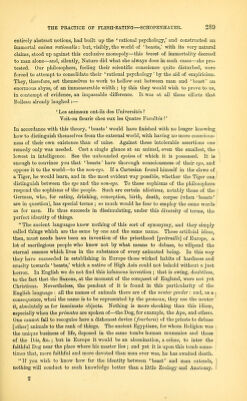
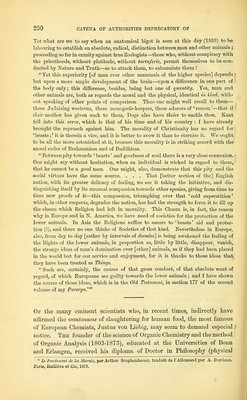
![Especially has he denounced the horrible outrage upon the commonest principles of justice by the pseudo-scientific torturers of the physiological laboratory.! It is thus that he lays the foundations of morality :— A Pity, without limits, which unites us with all living beings—in that we have the most solid, the surest guarantee of morality. With that there is no need of casuistry. Whoso possesses it will be quite incapable of causing harm or loss to any one, of doing violence to any one, of doing ill in any way. But rather he will have for all long-suffering, he will aid the helpless with all his powers, and each one of his actions will be marked with the stamp of justice and of love. Try to affirm : c this man is virtuous, only he knows no pity,' or rather: ' he is an unjust and wicked man : never- theless, he is compassionate.' The contradiction is patent to everyone. Each one to his taste : but for myself, I know no more beautiful prayer than that which the Hindus of old used in closing their public spectacles (just as the English of to-day end with a prayer for their king). They said: 'May All that have life be delivered from euffering!' Enforcing his teaching that the principles and mainspring of all moral action must be justice and love, Schopenhauer maintains that the real influence of these first of virtues is tested, especially, by the conduct of men to other animals :— Another proof that the moral motive, here proposed, is, in fact, the true one, is, that in accordance with it the lower animals themselves are protected. The unpar- donable forgetfulness in which they have been iniquitously left hitherto by all the [popular] moralists of Europe is well known. It is pretended that the [so- called] beasts have no rights. They persuade themselves that our conduct in regard to them has nothing to do with morals, or (to speak in the language of their morality) that we have no duties towards ' animals:' a doctrine revolting, gross, and barbarous, peculiar to the west, and which has its root in Judaism. In Philosophy, however, it is made to rest upon a hypothesis, admitted in the face of evidence itself, of an absolute difference between man and ' beast.' It is Descartes who has proclaimed it in the clearest and most decisive manner : and, in fact, it was a necessary consequence of his errors. The Cartesian-Leibnitzian-Wolfian philosophy, with the assistance of little established. Love is an inborn but differently distributed force and blood-heat of the heart (bliitwarme des herzens). There are cold and warm-blooded souls, as there are animals. As for the child, so for the lower animal, love is, in fact, an essential impulse; and this central fire often, in the form of compassion, pierces its earth-crust, but not in every case The child (under proper education) learns to regard all animal life as sacred—in brief, they impart to him the feeling of a Hindu in place of the heart of a Cartesian philosopher. There is here a question of something more even than compassion for other animals; but this also is in question. Why is it that it has so long been observed that the cruelty of the child to the lower animals presages cruelty to men, just as the Old-Testament sacrifice of animalsjpreshadowed that of the sacrifice of a man ? It is for himself only the undeveloped man can experience pains and suffer- ings, which speak to him with the native tones of his own experience. Consequently, the inarticulate cry of the tortured animal comes to him just as some strange, amusing sound of the air; and yet he sees there life, conscious movement, both which distinguish them from the inanimate substances. Thus he sins against his own life, whilst he sunders it from the rest, as though it were a piece of machinery. Let life be to him [the child] sacred (heilig), even that which may be destitute of reason ; and, in fact, does the child know any other ? Or, because the heart beats under bristles, feathers, or wings, is it, therefore, to be of no account ? t See a pamphlet upon this subject by Dr. V. Gutzlaff — Schopenhauer ueber die Tliiere und den Thierschutz: Bin Beitrag zur ethischen Seite der Vivisections/rage. Berlin, 1879.](https://iiif.wellcomecollection.org/image/b21084324_0304.jp2/full/800%2C/0/default.jpg)