The ethics of diet : a catena of authorities deprecatory of the practice of flesh-eating / by Howard Williams.
- Q15442840
- Date:
- 1883
Licence: Public Domain Mark
Credit: The ethics of diet : a catena of authorities deprecatory of the practice of flesh-eating / by Howard Williams. Source: Wellcome Collection.
Provider: This material has been provided by the Francis A. Countway Library of Medicine, through the Medical Heritage Library. The original may be consulted at the Francis A. Countway Library of Medicine, Harvard Medical School.
311/356 page 295
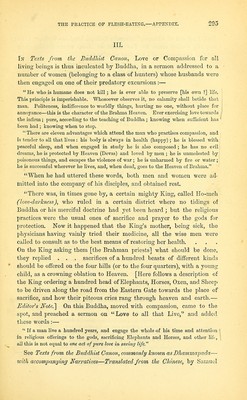
![III. In Texts from the Buddhist Canon, Love or Compassion for all living beings is thus inculcated by Buddha, in a sermon addressed to a number of women (belonging to a elass of hunters) whose husbands were then engaged on one of their predatory excursions :— He who is humane does not kill; he is ever able to preserve [his own ?] life. This principle is imperishable. Whosoever observes it, no calamity shall betide that man. Politeness, indifference to worldly things, hurting no one, without place for annoyance—this is the character of the Brahma Heaven. Ever exercising love towards the infirm; pure, according to the teaching of Buddha ; knowing when sufficient has ' been had ; knowing when to stop, There are eleven advantages which attend the man who practises compassion, and is tender to all that lives : his body is always in health (happy); he is blessed with peaceful sleep, and when engaged in study he is also composed; he has no e idl dreams, he is protected by Heaven (Devas) and loved by men ; he is unmolested by poisonous things, and escapes the violence of war; he is unharmed by fire or water; he is successful wherever he lives, and, when dead, goes to the Heaven of Brahma. When he had uttered these words, both men and women were ad- mitted into the company of his disciples, and obtained rest. There was, in times gone by, a certain mighty King, called Ho-meh (love-darkness), who ruled in a certain district where no tidings of Buddha or his merciful doctrine had yet been heard ; but the religious practices were the usual ones of sacrifice and prayer to the gods for protection. Now it happened that the King's mother, being sick, the physicians having vainly tried their medicine, all the wise men were called to consult as to the best means of restoring her health. On the King asking them [the Brahman priests] what should be done, they replied . . . sacrifices of a hundred beasts of different kinds should be offered on the four hills (or to the four quarters), with a young child, as a crowning oblation to Heaven. [Here follows a description of the King ordering a hundred head of Elephants, Horses, Oxen, and Sheep to be driven along the road from the Eastern Gate towards the place of sacrifice, and how their piteous cries rang through heaven and earth.— Editor's Note,'] On this Buddha, moved with compassion, came to the spot, and preached a sermon on Love to all that Live, and added these words :— If a man live a hundred years, and engage the whole of his time and attention in religious offerings to the gods, sacrificing Elephants and Horses, and other lift, all this is not equal to one act of pure love in saving life. See Texts from the Buddhist Canon, commonly Tcnown as Dhammapada— with accompanying Narratives—Translated from the Chinese, by Samuel](https://iiif.wellcomecollection.org/image/b21084324_0311.jp2/full/800%2C/0/default.jpg)