The ethics of diet : a catena of authorities deprecatory of the practice of flesh-eating / by Howard Williams.
- Q15442840
- Date:
- 1883
Licence: Public Domain Mark
Credit: The ethics of diet : a catena of authorities deprecatory of the practice of flesh-eating / by Howard Williams. Source: Wellcome Collection.
Provider: This material has been provided by the Francis A. Countway Library of Medicine, through the Medical Heritage Library. The original may be consulted at the Francis A. Countway Library of Medicine, Harvard Medical School.
320/356 page 304
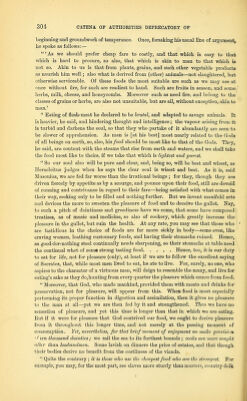
![beginning and groundwork of temperance. Once, forsaking his usual line of argument, he spoke as follows:— 'As we should prefer cheap fare to costly, and that which is easy to that which is hard to procure, so also, that which is akin to man to that which is not so. Akin to us is that from plants, grains, and such other vegetable products as nourish him well; also what is derived from (other) animals—not slaughtered, but otherwise serviceable. Of these foods the most suitable are such as we may use at once without fire, for such are readiest to hand. Such are fruits in season, and some herbs, milk, cheese, and honeycombs. Moreover such as need fire, and belong to the classes of grains or herbs, are also not unsuitable, but are all, without exception, akin to man.' Eating of flesh-meat he declared to be brutal, and adapted to savage animals. It is heavier, he said, and hindering thought and intelligence; the vapour arising from it is turbid and darkens the soul, so that they who partake of it abundantly are seen to be slower of apprehension. As man is [at his best] most nearly related to the Gods of all beings on earth, so, also, his food should be most like to that of the Gods. They, he said, are content with the steams that rise from earth and waters, and we shall take the food most like to theirs, if we take that which is lightest and purest So our soul also will be pure and clear, and, being so, will be best and wisest, as Heracleitus judges when he says the clear soul is wisest and best. As it is, said Musonius, we are fed far worse than the irrational beings ; for they, though they are driven fiercely by appetite as by a scourge, and pounce upon their food, still are devoid of cunning and contrivance in regard to their fare—being satisfied with what comes in their way, seeking only to be filled and nothing further. But we invent manifold arts and devices the more to sweeten the pleasure of food and to deceive the gullet. Nay, to such a pitch of daintiness and greediness have we come, that some have composed treatises, as of music and medicine, so also of cookery, which greatly increase the pleasure in the gullet, but ruin the health. At any rate, you may see that those who are fastidious in the choice of foods are far more sickly in body—some even, like craving women, loathing customary foods, and having their stomachs ruined. Hence, as good-for-nothing steel continually needs sharpening, so their stomachs at table need the continual whet of some strong tasting food Hence, too, it is our duty to eat for life, not for pleasure (only), at least if we are to follow the excellent saying of Socrates, that, while most men lived to eat, he ate to live. For, surely, no one, who aspires to the character of a virtuous man, will deign to resemble the many, and live for eating1 s sake as they do, hunting from every quarter the pleasure which comes from food. Moreover, that God, who made mankind, provided them with meats and drinks for preservation, not for pleasure, will appear from this. When food is most especially performing its proper function in digestion and assimilation, then it gives no pleasure to the man at all—yet we are then fed by it and strengthened. Then we have no sensation of pleasure, and yet this time is longer than that in which we are eating. But if it were for pleasure that God contrived our food, we ought to derive pleasure from it throughout this longer time, and not merely at the passing moment of consumption. Yet, nevertheless, for that brief moment of enjoyment we make provision r-f ten thousand dainties; we sail the sea to its furthest bounds ; cooks are more sought after than husbandmen. Some lavish on dinners the price of estates, and that though their bodies derive no benefit from the costliness of the viands. . Quite the contrary ; it is those who use the cheapest food who are the strongest. For example, you may, for the most part, see slaves more sturdy than masters, country-folk](https://iiif.wellcomecollection.org/image/b21084324_0320.jp2/full/800%2C/0/default.jpg)