The ethics of diet : a catena of authorities deprecatory of the practice of flesh-eating / by Howard Williams.
- Q15442840
- Date:
- 1883
Licence: Public Domain Mark
Credit: The ethics of diet : a catena of authorities deprecatory of the practice of flesh-eating / by Howard Williams. Source: Wellcome Collection.
Provider: This material has been provided by the Francis A. Countway Library of Medicine, through the Medical Heritage Library. The original may be consulted at the Francis A. Countway Library of Medicine, Harvard Medical School.
345/356 page 329
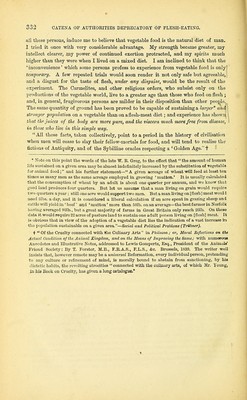
![The observations both of Bentham and of Mill upon this subject, slighted though they are, are pregnant with consequences. It is thus that the former authority expresses his opinion :— What other agents are those who, at the same time that they are under the influence of man's direction, are susceptible of Happiness ? They are of two sorts : (1) Other Human beings, who are styled Persons. (2) Other Animals who, on account of their interests having been neglected by the insensibility of the ancient Jurists, stand degraded into the class of Things. Under the Gentoo and Mahometan religions, the interests of the rest of the animal kingdom seem to have met with some attention. Why have they not, universally, with as much as those of human beings, allowance made for the differences in point of sensibih'ty ? Because the Laws that are have been the ivork of mutual fear—a sentiment which the less rational animals have not had the same means, as men have, of turning to account. Why ought they not [to have the same allowance made] ? TSo reason can be given . . . The day has been (and it is not yet past) in which the greater part of the Species, under the denomination of Slaves, have been treated by the Laws exactly upon the same footing—as in England, for example, the inferior races of beings are still. The day may come, when other Animals may obtain those rights which never could have \ been withholden from them but by the hand of Tyranny. The French have already (1790) recognised that the blackness of the skin is no reason why a human being should be abandoned, without redress, to the caprice of a tormentor. It may come one day to be recognised that the number of the legs, the villosity of the skin, or the termination of the os sacrum, are reasons equally insufficient for abandoning a sensitive being to the same fate. What else is it should fix the insu- perable line? Is it the faculty of reason, or, perhaps, the faculty of discourse? But a full-grown Horse or Dog is, beyond comparison, a more rational, as well as more conversable animal, than an infant of a day, or a week, or even of a month old. Bui suppose the case were otherwise, what would it avail ? The question is not, can they reason? Nor is it, can they talk ? But, can they suffer.? * >e< XVI. SINCLAIR 1754—183-5. This celebrated Agricultural Reformer and active promoter of various beneficent enterprises was a most voluminous writer. During sixty years he was almost constantly employed in producing more or less useful books. He was born at Thurso Castle, in Caithness, and received * Introduction to the Principles of Morals and legislation (page 311). By Jeremy Bentham, M.A., Bencher of Lincoln's Inn, &c.; Oxford: Clarendon Press, 1876. It must be added that the assumption (on the same page on which this cogent reasoning is found), that man has the right to kill his fellow-beings, for the purpose of feeding upon their flesh, is one more illustration of the strange inconsistencies into which even so generally just and independent a thinker as the author of the Book of Fallacies may be forced by the logic of circumstances. Among recent notable Essays upon the Bights of the Lower Animals (the right to live excepted) may here be mentioned— Animals and their Masters, by Sir Arthur Helps (1873),, and The Rights of an Animal, by Mr. E. B. Nicholson, librarian of the Bodleian, Oxford (1877),](https://iiif.wellcomecollection.org/image/b21084324_0345.jp2/full/800%2C/0/default.jpg)