Volume 5
Alle de brieven van Antoni van Leeuwenhoek / uitgegeven, geïllustreerd en van aanteekeningen voorzien door een Commissie van Nederlandsche geleerden.
- Antonie van Leeuwenhoek
- Date:
- 1939-
Licence: Public Domain Mark
Credit: Alle de brieven van Antoni van Leeuwenhoek / uitgegeven, geïllustreerd en van aanteekeningen voorzien door een Commissie van Nederlandsche geleerden. Source: Wellcome Collection.
45/518 (page 27)
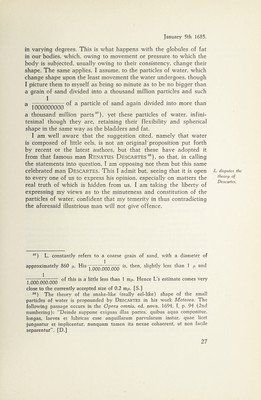
![in varying degrees. This is what happens with the globules of fat in our bodies, which, owing to movement or pressure to which the body is subjected, usually owing to their consistency, change their shape. The same applies, I assume, to the particles of water, which change shape upon the least movement the water undergoes, though I picture them to myself as being so minute as to be no bigger than a grain of sand divided into a thousand million particles and such 1 a . ~_of a particle of sand again divided into more than 1000000000 F a a thousand million parts37), yet these particles of water, infini¬ tesimal though they are, retaining their flexibility and spherical shape in the same way as the bladders and fat. I am well aware that the suggestion cited, namely that water is composed of little eels, is not an original proposition put forth by recent or the latest authors, but that these have adopted it from that famous man Renatus Descartes38), so that, in calling the statements into question, ! am opposing not them but this same celebrated man Descartes. This I admit but, seeing that it is open to every one of us to express his opinion, especially on matters the real truth of which is hidden from us, I am taking the liberty of expressing my views as to the minuteness and constitution of the particles of water, confident that my temerity in thus contradicting the aforesaid illustrious man will not give offence. L. disputes the theory of Descartes. 37) L. constantly refers to a coarse grain of sand, with a diameter of 1 approximately 860 y. His j qqq qqq qqq *s> then, slightly less than 1 /x and 1 1.000.000.000 of this is a little less than 1 m/x. Hence L’s estimate comes very close to the currently accepted size of 0.2 m/x. [S.] 38) The theory of the snake-like (really eel-like) shape of the small particles of water is propounded by Descartes in his work Meteora. The following passage occurs in the Opera omnia, ed. nova, 1694, I, p. 94 (2nd numbering): “Deinde suppone exiguas illas partes, quibus aqua componitur, longas, laeves et lubricas esse anguillarum parvularum instar, quae licet jungantur et implicentur, nunquam tarnen ita nexae cohaerent, ut non facile separentur”. [D.]](https://iiif.wellcomecollection.org/image/b31364962_0005_0045.jp2/full/800%2C/0/default.jpg)