Volume 10
Alle de brieven van Antoni van Leeuwenhoek / uitgegeven, geïllustreerd en van aanteekeningen voorzien door een Commissie van Nederlandsche geleerden.
- Antonie van Leeuwenhoek
- Date:
- 1939-
Licence: Public Domain Mark
Credit: Alle de brieven van Antoni van Leeuwenhoek / uitgegeven, geïllustreerd en van aanteekeningen voorzien door een Commissie van Nederlandsche geleerden. Source: Wellcome Collection.
63/390 (page 47)
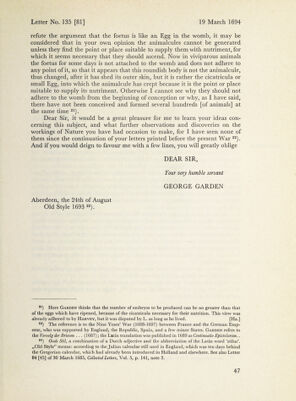
![refute the argument that the foetus is like an Egg in the womb, it may be considered that in your own opinion the animalcules cannot be generated unless they find the point or place suitable to supply them with nutriment, for which it seems necessary that they should ascend. Now in viviparous animals the foetus for some days is not attached to the womb and does not adhere to any point of it, so that it appears that this roundish body is not the animalcule, thus changed, after it has shed its outer skin, but it is rather the cicatricula or small Egg, into which the animalcule has crept because it is the point or place suitable to supply its nutriment. Otherwise I cannot see why they should not adhere to the womb from the beginning of conception or why, as I have said, there have not been conceived and formed several hundreds [of animals] at the same time 21). Dear Sir, it would be a great pleasure for me to learn your ideas con¬ cerning this subject, and what further observations and discoveries on the workings of Nature you have had occasion to make, for I have seen none of them since the continuation of your letters printed before the present War 22). And if you would deign to favour me with a few lines, you will greatly oblige DEAR SIR, Tour very humble servant GEORGE GARDEN Aberdeen, the 24th of August Old Style 1693 23). 21) Here Garden thinks that the number of embryos to be produced can be no greater than that of the eggs which have ripened, because of the cicatricula necessary for their nutrition. This view was already adhered to by Harvey, but it was disputed by L. as long as he lived. [Ha.] 2a) The reference is to the Nine Years’ War (1688-1697) between France and the German Emp¬ eror, who was supported by England, the Republic, Spain, and a few minor States. Garden refers to the Vervolg der Brieven . . . (1687); the Latin translation was published in 1689 as Continuatio Epistolarum.. 23) Oude Stil, a combination of a Dutch adjective and the abbreviation of the Latin word ’stilus’. „Old Style” means: according to the Julian calendar still used in England, which was ten days behind the Gregorian calendar, which had already been introduced in Holland and elsewhere. See also Letter 84 [45] of 30 March 1685, Collected Letters, Vol. 5, p. 141, note 3.](https://iiif.wellcomecollection.org/image/b31364962_0010_0063.jp2/full/800%2C/0/default.jpg)