Avogadro and Dalton: the standing in chemistry of their hypotheses / by Andrew N. Meldrum, D.SC ; with a preface by Francis R. Japp.
- Andrew Norman Meldrum
- Date:
- 1904
Licence: In copyright
Credit: Avogadro and Dalton: the standing in chemistry of their hypotheses / by Andrew N. Meldrum, D.SC ; with a preface by Francis R. Japp. Source: Wellcome Collection.
Provider: This material has been provided by Royal College of Physicians, London. The original may be consulted at Royal College of Physicians, London.
85/124 page 81
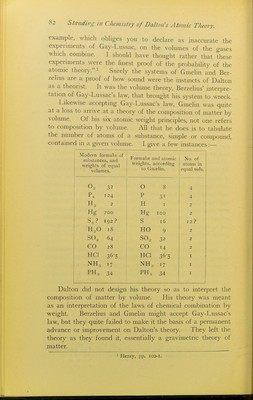
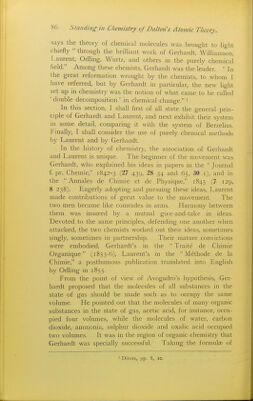
![this that Gmelin laid clown the principle, Let no atomic weights be admitted smaller than those which actually occur in combinations. (Principle 6.) This, a mere platitude but for the teaching- of Berzelius, was actually a timely, weighty reminder of an axiom of Dalton's theory. Gmelin's principle implied adherence to Dalton's atom in its integrity. In order to explain why Berzelius' system was supplanted by Gmelin's, there is therefore no need to suppose, with Ladenburg, that the atomic theory had been abandoned and discredited by the majority of chemists. The only important difference between the two leaders arose from the volume theory. Plausible at first sight, the longer this theory was looked at, the more suspicious it became. Berzelius had to fritter away the theory in more ways than one. Limiting it at first to the elements, he had to limit it still further, under the pressure of Dumas' facts, to a .small number of the elements. Again, thoug^li as a matter of course he had begun with the assumption that the physical atom and the chemical atom were identical, Berzelius found himself constrained to assume the existence of an atom which was indivisible chemically and physically divisible. Even the authority of Berzelius was inadequate to recommend a system that had become a welter of conflicting ideas and principles. No wonder that his system fell into disrepute, and that Gmelin's came more and more into vogue.^ The characteristic feature of the period of chemistry during- which the systems of Berzelius and Gmelin were in vogue is the study of the composition of matter by weight. It is a significant fact that during all that time chemists simply failed in their attempts to get Gay-Lussac's law and the current theory of chemistry to elucidate one-another. Dalton could find no place for the law in his atomic theory. In 1812, Berzelius wrote to Dalton, expostulating with him for his refusal to accept Gay-Lussac's law. ... There are parts of [the atomic] theory, much as science owes to you at present, which demand a little alteration. That part, for ' About this lime, the chemical doctrines generally of Berzelius fell into disrepute. Here, only the direct causes of the downfall of his atomic weight system have been mentioned.](https://iiif.wellcomecollection.org/image/b22651743_0085.jp2/full/800%2C/0/default.jpg)

 No text description is available for this image
 No text description is available for this image
 No text description is available for this image