Report of the Royal Commission on the Poor Laws and Relief of Distress. : Appendix Volume XX. Report by Mr. Cyril Jackson on boy labour together with a memorandum from the General Post Office on the conditions of employment of telegraph messengers.
- Royal Commission on the Poor Laws and Relief of Distress 1905-09
- Date:
- 1909
Licence: In copyright
Credit: Report of the Royal Commission on the Poor Laws and Relief of Distress. : Appendix Volume XX. Report by Mr. Cyril Jackson on boy labour together with a memorandum from the General Post Office on the conditions of employment of telegraph messengers. Source: Wellcome Collection.
Provider: This material has been provided by London School of Hygiene & Tropical Medicine Library & Archives Service. The original may be consulted at London School of Hygiene & Tropical Medicine Library & Archives Service.
244/276 (page 208)
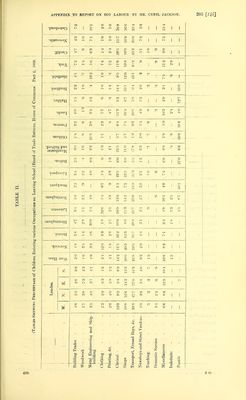
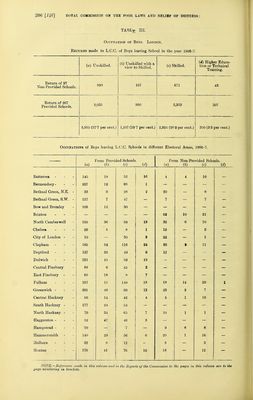
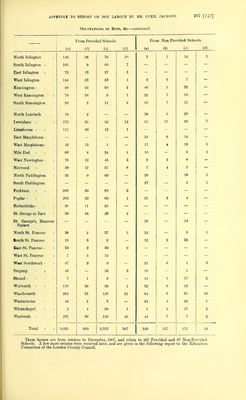
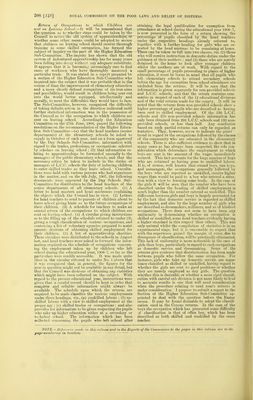
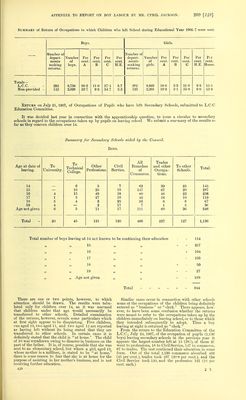
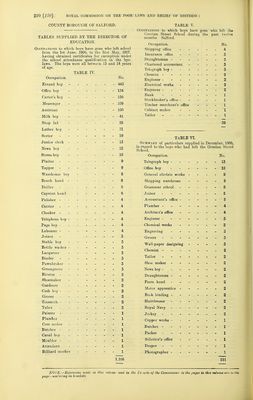
![Return of Occupations to xvldch Children are sent on Leavnui School.—It will be remembered that the question as to whether steps could be taken by the Council to revive the oM system of appfenticeshil)S;tJr ~ wiiether some other means could be adopted to secure that children on leaving school should receive thorough training in some skilled occupation, Las formed the subject of-inquiry on the part of the Higher Education Sub-Committee. The inquiry has shown that the old system of indentured apprenticeship has for many years been falling into decay without any adequate substitute. It appears that it is becoming increasingly rare to find cases of workmen ■who have thoroughly mastered a particular trade. It was stated in a report prepared bv a section of the Higher Education Sub-Committee who inquired into the subject that it was probable that in the course of time the improvement of elementary education and a more clearly defined recognition of its true aims and possibilities, would result in children being sent out into the world better equipped, intellectually and morally, to meet the difficulties they would have to face. The Sub-Committee, however, recognised the difficulty of taking definite action in the direction indicated until further statistical information was in the possession of the Council as to the occupation to Avhich children are sent on leaving school. Accordingly the Education Committee on the 27th June, 1906, passed the following resolutions on the recommendation of the Higher Educa- tion Sub-Committee—{a) that the head teachers (senior departments) of the elementary schools be asked to supply in October of each year, and on a form approved by the • Day Schools Sub-Committee, information with regard to the trades, professions, or occupations selected by scholars on leaving school; (6) that information re- lating to apprenticeships be forwarded annually to the managers of the public elementary schools, and that the necessary action be taken to include in the duties of managers of L.C.C. schools the duty of inducing children to enter skilled trades as they leave school. Consulta- tions -were held with various persons who had experience in the matter, and on the 9th July, 1907, the following documents were api:)roved by the Day Schools Sub- Committee for distribution to the head teachers of the senior departments of all elementary schools. (1) A letter to head masters and head mistresses explaining the objects which the Council has in view. (2) Letters for head teachers to send to parents of children about to leave school giving hints as to the future occupations of their children. (3) A schedule for teachers to make an annual return of the occupations to which children are sent on leaving school. (4) A circular giving instructions as to the filling up of the schedule referred to under (3), giving a rough classification of various occupations, and containing a list of voluntary agencies prepared to assist parents desirous of obtaining skilled employment for their children. (5) A list of apprenticeship charities. These circulars were distributed to the schools in August last, and head teachers were asked to forward the infor- mation required on the schedule of occupations concern- ing the employment taken up by children who left school during the educational year, 1906-7, so far as the particulars were readily accessible. It was made quite clear in the circular referred to under No. 1 above that it was recognised that, in general, the figures for the year in question might not be available in any detail, but that the Council was desirous of obtaining any statistics which might have been collected on the subject. With regai'd to the present educational year, instructions were given that a careful record should be kept in order that complete a,nd reliable information might always be available. The schedule upon which the returns are required to be made classifies the various emjiloyments under three headings, viz., (a) unskilled labour ; (]>) un- skilled labour with a ^'iew to skilled employment at the proper age ; (c) skilled trades or occupations : and also provides for information to be given respecting the pupils who tiike up higher education either at a secondary or tec^hnical school. The information which has been collected concerning the pupils v^ho-left school after attaining the legal qualification for exemption from attendance at school during the educational year 1906-7, is now presented in the form of a return showing the ' percentage~6f 'pupils classified 15yl;he head teacliers under the respective headings already referred to, together with a further heading for girls who are re- ported by the head mistress to be remaining at home. ' These-can be taken-to fall into two classes, viz. (1) those who will receive instruction in domestic duties under the guidance of their mothers : and (2) those who are merely detained in the home to look after younger cliildren whilst the mothers are at work. With regard to the small percentage of pupils ijroceeding to places of higher education, it must be borne in mind that all jjupils who left elementary schools to attend secondary schools before the age for exemption from school attendance are excluded from the returns. It will be seen that the information is given separately for non-provided schools and L.C.C. schools, and that the return contains sum maries m respect of each of the 12 educational divisions and of the total returns made for the coun+y. It will be noted that the returns from non-provided schools shov. a higher percentage of pupils who are described as having been sent to skilled employment. Of the 536 L.C.C. schools and 370 non-provided schools information has only been obtained from 292 L.C.C. schools and 133 non- provided schools, or less than half. Any conclusion based on such partial returns can only be regarded as tentative. They, however, serve to indicate the gener trend in regard to tlie occupations followed by the classes of the community who are educated in the elementary schools. There is also sufficient evidence to show that in many cases as has always been suspected, the sole con- sideration which determines the emijloyment to which boys are sent is the amount of the wages immediately secured. This fact accounts for the large number of boys who are returned as having gone to unskilled labour. It is, of course, well known that errand boys, van bays, and messengers, the occupations generally followed by the boys who are reported as unskilled, receive higher wages than would be paid to a boy who entered a situa- tion with a view to learning some trade. In the case of the girls it will be seen that the number who have been classified under the heading of skilled employment is much higher than the number entered as unsltilled. This difference between girls and boys is largely accounted for by the fact that domestic service is regarded as skilled employment, and also by the large number of girls who are described as dressmakers, milliners, and as of kindred occupations. There does not seem to have been any uniformity in determining whether an occupation is skilled or unskilled, some head teachers evidently having a higher standard in this respect than others. This was only natural whilst the compilation of statistics is in an experimental stage, but it is reasonable to expect that with the experience gained the margin of error, due to divergence of classification, will be practically eliminated. This lack of uniformity is more noticeable in the case of girls than boys, particularly in regard to such occupations as domestic service and dressmaking. Some of the returns give evidence that discrimination has been made between pupils who follow the same occupation. For instance, girls who take up domestic service are some- times classified as skilled or unskilled, having regard to whether the girls are sent to good positions or whether they are merely employed as day girls. The question whether this is desirable or whether a more rigid classifi- cation with careful sub division is not more likely to lead to accurate results is one that will need consideration when the procedure relating to next year's returns is under consideration. I propose to submit a report to the Section of the Higher Education Sub-Committee ap- pointed to deal with the question before the Easter recess. It may be found desirable to adopt the classifi- cation used in the Census returns. In the case of the boys the occupation which has presented some difficulty of classification is that of office boy, which has been described as both skilled and unskilled by the same teacher. NOTE.—References made in this volume and in the Beports oj the Commission to the pages 171 this volume are to the](https://iiif.wellcomecollection.org/image/b24399966_0244.jp2/full/800%2C/0/default.jpg)