Report of the Royal Commission on the Poor Laws and Relief of Distress. : Appendix Volume XX. Report by Mr. Cyril Jackson on boy labour together with a memorandum from the General Post Office on the conditions of employment of telegraph messengers.
- Royal Commission on the Poor Laws and Relief of Distress 1905-09
- Date:
- 1909
Licence: In copyright
Credit: Report of the Royal Commission on the Poor Laws and Relief of Distress. : Appendix Volume XX. Report by Mr. Cyril Jackson on boy labour together with a memorandum from the General Post Office on the conditions of employment of telegraph messengers. Source: Wellcome Collection.
Provider: This material has been provided by London School of Hygiene & Tropical Medicine Library & Archives Service. The original may be consulted at London School of Hygiene & Tropical Medicine Library & Archives Service.
245/276 (page 209)
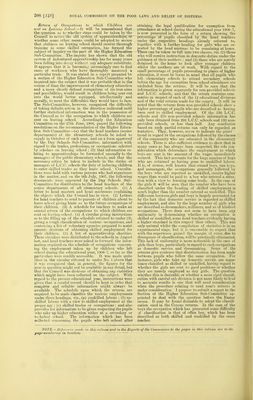
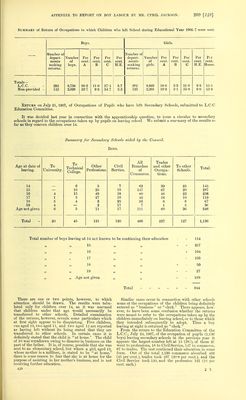
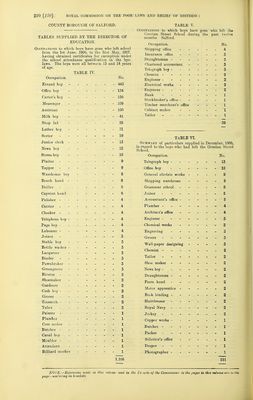
![Summary of Return of Occupations to which Children who left School during Educational Year 1906-7 were sent. Boys. Girls. Number of Number of depart- Number Per Per Per Per depart- ^^umber Per Per Per Per P.r ments of cent. cent. cent. cent. ments of cent. cent. cent. cent. cent. making boys. A B C H.E. making girls. A B C H.E. Hoine. returns. returns. Totals— L.CC. - 292 8,756 58-2 11-0 271 3.7 2P2 8,669 18-0 5-3 51-9 9-3 1.5-5 Non-provided - 112 2,028 53-7 9-3 34 7 2.3 133 2,201 19-3 5-1 55-8 6 0 13-8 Return on July 21, 1907, of Occupations of Pupil.s who have left Secondary Schools, submitted to L.CC Education Committee. It was decided last year in connection with the appienticeship question, to issue a circular to secondary schools in regard to the occupations taken up by pupils on leaving school. Wc submit a summary of the results as far as they concern children over 14. Summary for Secondary Schools aided hy the Council. Boys. Age at date of leaving. To University. To Technical College. Other Professions. Civil Service. All Branches of Commerce. Trades and other Occupa- tions. To other Schools. Total. 14 6 5 7 63 39 25 145 15 10 25 18 147 67 20 287 16 4 15 48 18 bO 48 23 236 17 1 5 27 18 42 16 10 119 18 5 4 3 25 16 6 8 67 19 4 2 17 7 1 5 36 Age not given 6 5 11 17 111 60 36 246 Total 20 45 121 120 466 237 127 1,136 Total number of boys leaving at 14 net known to be continuing their education - - 114 „ „ 15 ,, - - 257 1) !> 16 ,, „ - 194 „ , 17 „ „ - 103 „ „ 18 „ „ - - 50 j> )) 19 » )) 2'^ „ „ Age not given „ „ - - 199 Total 944 There are one or two points, however, to which attention should be drawn. The results were tabu- lated only for children over 14, as it was assumed that children under that age would necessarily be transferred to other schools. Detailed examination of the returns, however, reveals some particulars which at first sight appear to be disquieting. Five children, one aged 10, two aged 11, and two aged 12 are reported as having left without its being stated that they are transferred to other schools. In certain cases it is definitely stated that the child is at home. The child of 10 was witndrawn owing to disaster in business on the part of the father. It is, of course, possible that she was sent to an elementary school, but where a girl, aged 12, whose mother is a milliner, is stated to be at home, there is some reason to fear that she is at home for the pur]30se of assisting in her mother's business, and is not receiving further education. 429 Similar cases occur in connection with other schools some ot the occupations of the children being definitely entered as business or clerk. There appears, how- ever, to have been some confusion whether the returns were meant to refer to the occupations taken up by the children immediately on leaving school, or to those which they intended subsequently to adopt. Thus a boy leaving at eight is returned as clerk. From the return to the Education Committee of the L.CC, July 24, 1907, of the occupation of pupUs (1,136 boys) leaving secondary schools in the previous year it appears the largest number left at 15 (287), of these 2c went to professions, 18 to Civil Service, 147 to commerce, 67 to trades. The rest continued their education in some form. Out of the total 1,136 commerce absorbed 466 (41 per cent.), trades took 237 (20'8 per cent.), and the Civil Service took 120, and the profession 121 (10 per cent, each.)](https://iiif.wellcomecollection.org/image/b24399966_0245.jp2/full/800%2C/0/default.jpg)