Volume 1
The horse : its treatment in health and disease with a complete guide to breeding, training and management / edited by J. Wortley Axe.
- Date:
- [1906]
Licence: Public Domain Mark
Credit: The horse : its treatment in health and disease with a complete guide to breeding, training and management / edited by J. Wortley Axe. Source: Wellcome Collection.
61/272 page 29
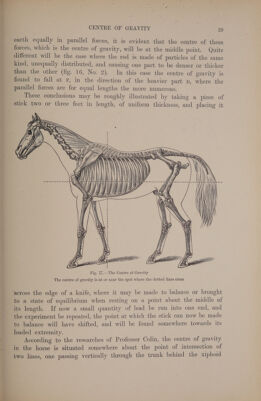
![. — CENTRE OF GRAVITY 29 earth equally in parallel forces, it is evident that the centre of these forces, which is the centre of gravity, will be at the middle point. Quite different will be the case where the rod is made of particles of the same than the other (fig. 16, No. 2). In this case the centre of gravity is found to fall at F, in the direction of the heavier part D, where the parallel forces are for equal lengths the more numerous. _ These conclusions may be roughly illustrated by taking a piece of —— ee = ROO i é, ANG é WY. \ GF i \\\ . .\\ y | 7 \ \\ \ V\\ WN ) | | IN (iN i} \ | 1 | iN} i!) ] to a state of equilibrium when resting on a point about the middle of its length. If now a small quantity of lead be run into one end, and the experiment be repeated, the point at which the stick can now be made to balance will have shifted, and will be found somewhere towards its loaded extremity. 7 . According to the researches of Professor Colin, the centre of gravity in the horse is situated somewhere about the point of intersection of two lines, one passing vertically through the trunk behind the xiphoid](https://iiif.wellcomecollection.org/image/b32843082_0001_0061.jp2/full/800%2C/0/default.jpg)
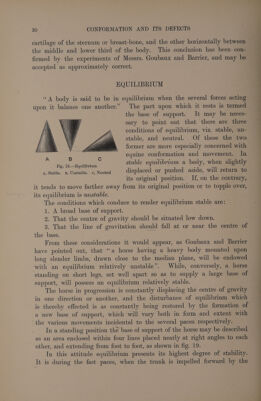
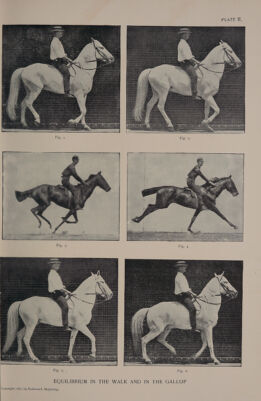
 No text description is available for this image
 No text description is available for this image
 No text description is available for this image