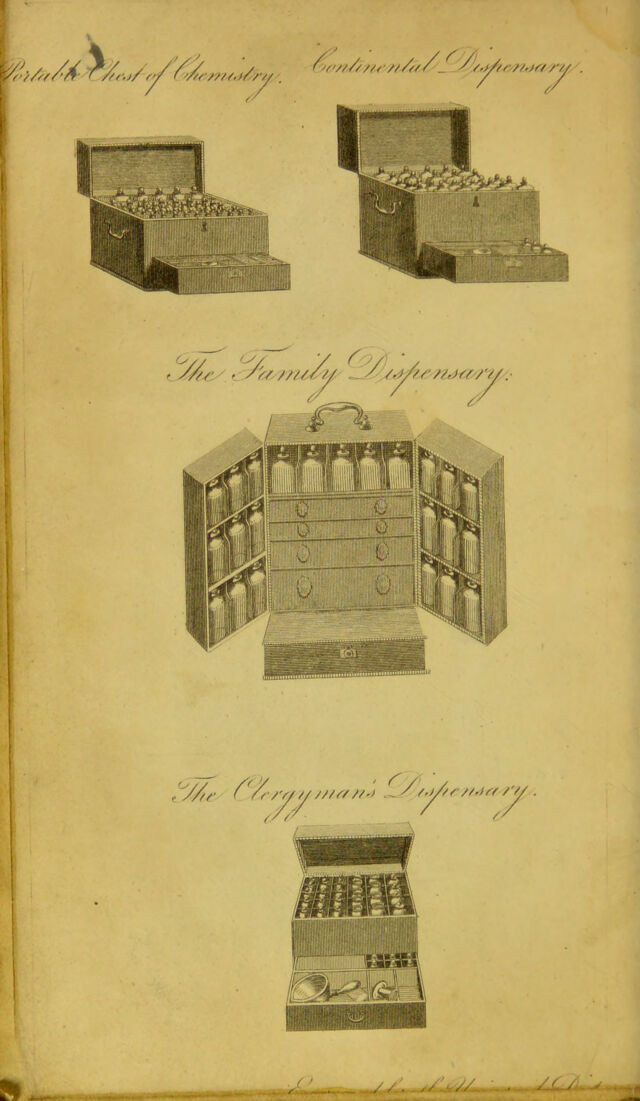
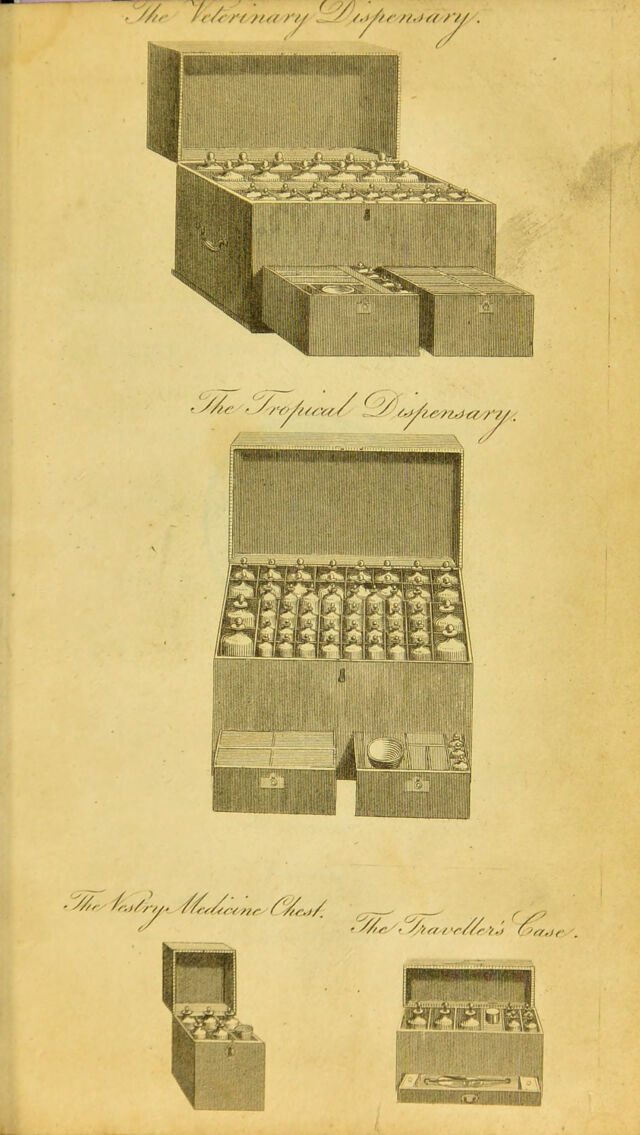
The universal dispensatory : containing companions to the tropical, the continental, the family, the country clergyman's, the traveller's, and the military, or officer's dispensaries, or medical chests : detailing the properties, doses, and best methods of exhibiting the contents of each chest, in different climates and countries / by Reece and Co.
- Reece and Co.
- Date:
- 1814
Licence: Public Domain Mark
Credit: The universal dispensatory : containing companions to the tropical, the continental, the family, the country clergyman's, the traveller's, and the military, or officer's dispensaries, or medical chests : detailing the properties, doses, and best methods of exhibiting the contents of each chest, in different climates and countries / by Reece and Co. Source: Wellcome Collection.
Provider: This material has been provided by The Royal College of Surgeons of England. The original may be consulted at The Royal College of Surgeons of England.
91/92 page 79
![made by the fingers, or a strong pad, or firm body, pressed very strongly- From the groin, the artery proceeds in an oblique direc- tion downwards and inwards, as expressed by the line C; and about the middle oi the inside of the thigh, ex])ressed by the compi*ess D, it lies close to the bone, which of course is the most favourable part for making a pressure on it, because of the resistance of the thigh bone; and when the wound is in any part beloxo it, this is the place which surgeons fix on for the application of the pad of the tourniquet. The course of the vessel is then downwards and backwards to the ham ; in the hollow of which, against the lower flat part of the thigh bone, the compression may be very successfully made in all cases of wounds or opera- tions below the knee joint; but, beyond this part, com- pression must not be depended on, for immediately below the joint the artery divides, like that of the upper extre- mity, into three vessels, which are situated between the bones of the leg. In using the tourniquet, great care must be taken that the pad, D, be applied over the artery, and the instru- ment itself as nearly opposite to it as possible. The ban- dage, H, is then to be conducted round the limb, passed through the opening of the instrument behind the roller, drawn over it very tight, and secured by fixing it on the three steel points, I: in most instances this will be found sufficient; but if it should not, a few turns of the screw, G, will effectually complete the intention. The pad, or compress, is not, in all cases, necessary; and, even when the discharge of blood is considerable, if there be any doubt about the exact place to which it should be applied, it may be omitted entirely. The circular ban- dage, when made tight, will effectually compress both the trunk and the collateral branches of the artery ; and, there- fore, many surgeons consider the pad useless. When it happens not to be applied-over the artery, but on one side of it, the pad may prevent the compression of the artery by the circular bandage, in consequence of which, the blood will continue to flow. Such a circumstance 1 have known to happen during the amputation of a limb at one of the London hospitals. If the wound be in the head, or trunk of the body, the most cfl'ectual and easiest method of applying pressure, is by means of dossels of lint, or soft linen, held firmly upon](https://iiif.wellcomecollection.org/image/b22346314_0093.jp2/full/800%2C/0/default.jpg)