Licence: Public Domain Mark
Credit: Annual sanitary report of the Province of Assam. Source: Wellcome Collection.
36/104 page 14
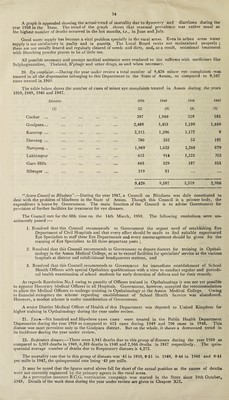
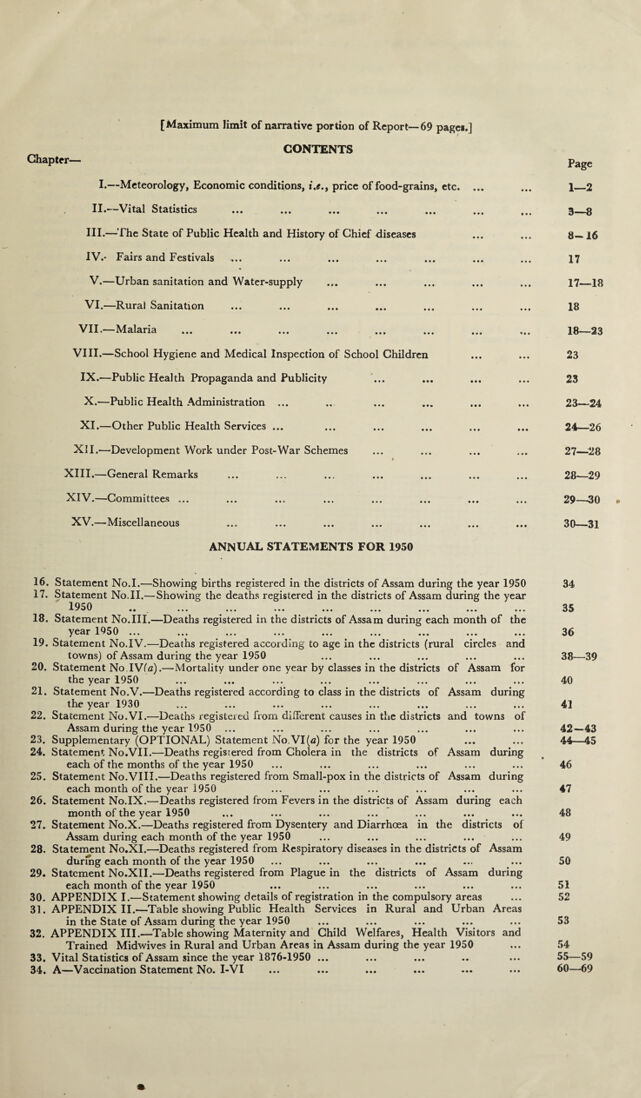
![14 A graph is appended showing the actual trend of mortality due to dysentery and diarrhoea during the year 1950 in the State. The trend of the graph shows that seasonal prevalence was rather usual as the highest number of deaths occurred in the hot months, i.e., in June and July. Good water supply has become a vital problem specially in the rural areas. Even in urban areas water supply is not satisfactory in quality and in quantity. The Local Board tanks not maintained properly ; these are not usually fenced and regularly cleared of weeds and dirts, and, as a result, occasional treatment with Bleaching powder proves to be of little use. All possible necessary and prompt medical assistance were rendered to the sufferers with medicines like' Sulphaguanidine, Thalazol, B’phage and other drugs, as and when necessary. 20. Eye complaints.—During the year under review a total number of 9,426 minor eye complaints was- treated in all the dispensaries belonging to this Department in the State of Assam, as compared to 9,587 cases treated in 1949. The table below shows the number of 1950, 1949, 1948 and 1947. cases of minor eye complaints treated in Assam during the years Districts 1950 1949 1948 194T (1) (2) f3) (4) (5) Cachar ... ... 397 1,040 529 185 Goalpara... • • • • • • 2,488 3,453 1,190 1,469 Kamrup ... ... 2,315 1,596 1,177 9 Darrang ... • • • • • • 760 262 55 191 Nowgong... • • • • • • 1,969 1,622 1,260 879 Lakhimpur • • • • • • 615 914 1,121 Nil Garo Hills • • • • • • 663 529 187 25a Sibsagar ... • • • • • • 219 81 ... .... 9,426 9,587 5,519 2,986 “Assam Council on Blindness”.—During the year 1947, a Council on Blindness was duly constituted to deal with the problem of blindness in the State of Assam. Though this Council is a private body, the expenditure is borne by Government. The main function of the Council is to advise Government for provision of further facilities for treatment for eye diseases. The Council met for the fifth time on the 14th March, 1950. The following resolutions were un¬ animously passed :— ]. Resolved that this Council recommends to Government the urgent need of establishing Eye Department of Civil Hospitals and that every effort should be made to find suitable experienced Eye Specialists to staff these Eye Departments and every encouragement should be given for the training of Eye Specialists to fill these important posts ; 2. Resolved that this Council recommends to Government to depute doctors for training in Opthal- mology in the Assam Medical College, so as to extend facilities for specialists’ service at the various hospitals at district and subdivisional headquarters stations, and 3. Resolved that this Council recommends to Government for immediate establishment of School Health Officers with special Opthalmic qualifications with a view to conduct regular and periodi¬ cal health examination of school students for early detection of defects and for their remedy. As regards Resolution No.l owing to paucity of Officers trained in Opthalmology it was not yet possible to appoint Honorary Medical Officers in all Hospitals. Government, however, accepted the recommendation to allow the Medical Officers to undergo training in Opthalmology at the Assam Medical College. Owing to financial stringency the scheme regarding establishment of School Health Service was abandoned. However, a modest scheme is under consideration of Government. A senior District Medical Officer of Health of this Department was deputed to United Kingdom for higher training in Opthalmology during the year under review. 21. Tawf.—Six hundred and fifty-three yaws cases were treated in the Public Health Department Dispensaries during the year 1950 as compared to 615 cases during 1949 and 706 cases in 1948. This disease was most prevalent only in the Goalpara district. But on the whole, it shows a downward trend in its incidence during the year under review. 22. Respiratory diseases.—There were 3,941 deaths due to this group of diseases during the year 1950 as compared to 3,919 deaths in 1949, 6,339 deaths in 1948 and 2,966 deaths in 1947 respectively. The quin¬ quennial average number of deaths due to Respiratory diseases is 4,275. The mortality rate due to this group of diseases was *45 in 1950, 0-51 in 1949, 0’44 in 1948 and O’41 per mille in 1947, the quinquennial rate being ’43 per mille. It may be noted that the figures noted above fall far short of the actual position as the causes of deaths were not correctly registered by the primary agents in the rural areas. As a preventive measure B.C.G. vaccination campaign was started in the State since 10th October,](https://iiif.wellcomecollection.org/image/b31681001_0036.jp2/full/800%2C/0/default.jpg)




 No text description is available for this image
 No text description is available for this image
 No text description is available for this image