Catalogue of the specimens illustrating the osteology and dentition of vertebrated animals, recent and extinct : contained in the Museum of the Royal College of Surgeons of England / by William Henry Flower.
- Royal College of Surgeons of England
- Date:
- 1907-
Licence: In copyright
Credit: Catalogue of the specimens illustrating the osteology and dentition of vertebrated animals, recent and extinct : contained in the Museum of the Royal College of Surgeons of England / by William Henry Flower. Source: Wellcome Collection.
455/468 (page 425)
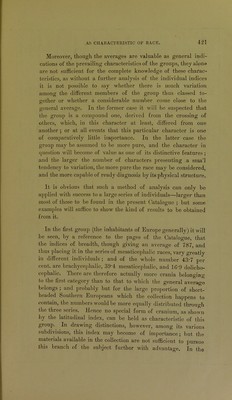
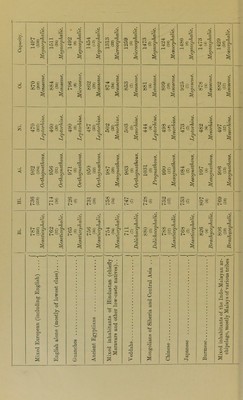
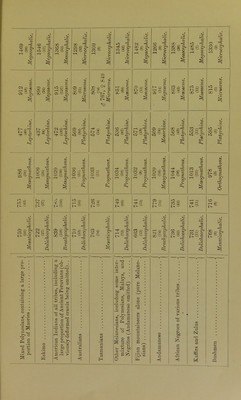
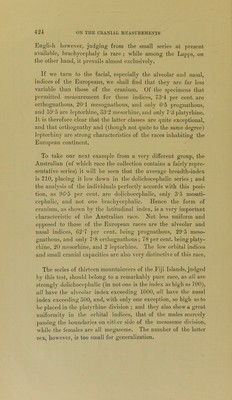
![Without entering into further details, which can be obtained by any one from an examination of the measurements given in the Catalogue, the general result may be stated to be that the ])revailing characteristics of all the races placed first on the list (including those of Europe, North Africa, and South-west Asia) arc a variable or moderate latitudinal index, a low alveolar index, a low nasal index, a moderate orbital index, and a high cerebral capacity. In other words, they are mesaticephalic, ortho- gnathous, leptorhine, megaseme, and megacephalic. The next group, or Mongoloid races, also vary much as to latitudinal index, including the extremely brachycephalic Siberian Mongols and Peruvians and the extremely dolicho^ cephalic Eskimo. They are rarely either truly orthognathous or prognathous, though with a great tendency to the latter, especially in the American branches. The nasal index is usually low; and the Eskimo are the most leptorhine of all known races. The orbital index is usually high, and the cranial capacity very variable. In the Australian and the dark races with frizzly hair, doli- chocephaly prevails almost universally, reaching its extreme in certain Melanesians. These races are equally characterized by prognathism, by the high nasal index (all the true platyrhine races belonging to this group), and by moderate or small cranial capacities. The Negritos of the Indo-Mahiyan archipelago (represented in the collection by the Andamanese) and, to a less extent, the Bushmen of South Africa present certain exceptional characters of great interest. It may fairly be inferred from these examples of the results of V hat is only an elementary and imperfect system of mensuration applied to crania, that when pursued in greater detail, wdth more ample materials and with more extended experience of what is imporhint and what only of secondary value, this method of in- vestigation, so far from being profitless, as some anthropologists have assumed, will prove of the greatest value in determining the nature and amount of the resemblances and ditferences in the physical characters of the various groups into which the human species is divided, and thereby in throwing light ujion their relations to one another, their history, and their origin.](https://iiif.wellcomecollection.org/image/b28119393_0455.jp2/full/800%2C/0/default.jpg)