A catalogue of the Ethiopic Biblical manuscripts in the Royal Library of Paris, and in the library of the British and Foreign Bible Society; also some account of those in the Vatican Library at Rome ... To which are added, specimens of versions of the New Testament into the modern languages of Abyssinia / and a grammatical analysis of a chapter in the Amharic dialect. With facsimiles of an Ethiopic and an Amharic manuscript.
- Bibliothèque nationale
- Date:
- 1823
Licence: Public Domain Mark
Credit: A catalogue of the Ethiopic Biblical manuscripts in the Royal Library of Paris, and in the library of the British and Foreign Bible Society; also some account of those in the Vatican Library at Rome ... To which are added, specimens of versions of the New Testament into the modern languages of Abyssinia / and a grammatical analysis of a chapter in the Amharic dialect. With facsimiles of an Ethiopic and an Amharic manuscript. Source: Wellcome Collection.
47/100 (page 39)
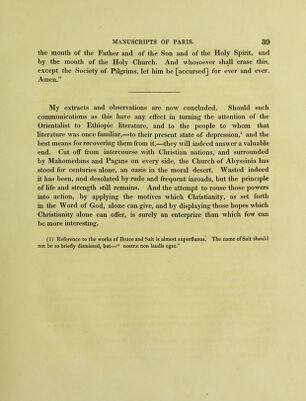
![the mouth of the Father and of the Son and of the Holy Spirit, and by the mouth of the Holy Church. And whosoever shall erase this, except the Society of Pilgrims, let him be [accursed] for ever and ever. Amen.” My extracts and observations are now concluded. Should such communications as this have any effect in turning the attention of the Orientalist to Ethiopic literature, and to the people to whom that literature was once familiar,—to their present state of depression,1 and the best means for recovering them from it,—they will indeed answer a valuable end. Cut off from intercourse with Christian nations, and surrounded by Mahomedans and Pagans on every side, the Church of Abyssinia has stood for centuries alone, an oasis in the moral desert. Wasted indeed it has been, and desolated by rude and frequent inroads, but the principle of life and strength still remains. And the attempt to rouse those powers into action, by applying the motives which Christianity, as set forth in the Word of God, alone can give, and by displaying those hopes which Christianity alone can offer, is surely an enterprize than which few can be more interesting. (1) Reference to the works of Bruce and Salt is almost superfluous. The name of Salt should not be so briefly dismissed, but—“ nostrae non laudis eget.”](https://iiif.wellcomecollection.org/image/b22009292_0047.jp2/full/800%2C/0/default.jpg)