Aspects of genetics in paediatrics : scientific proceedings of the 3d Unigate Workshop held at the Royal College of Physicians, St. Andrew's Place, London, May 1975 / edited by Donald Barltrop.
- Unigate Paediatric Workshop 1975 : London, England)
- Date:
- 1976
Licence: Attribution-NonCommercial-NoDerivatives 4.0 International (CC BY-NC-ND 4.0)
Credit: Aspects of genetics in paediatrics : scientific proceedings of the 3d Unigate Workshop held at the Royal College of Physicians, St. Andrew's Place, London, May 1975 / edited by Donald Barltrop. Source: Wellcome Collection.
21/136 page 9
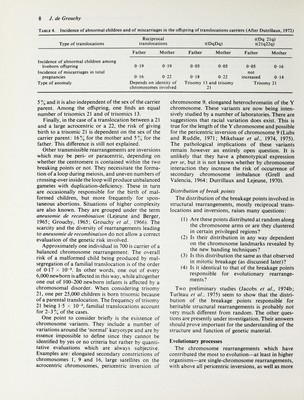
![Human chromosomes and their anomalies 9 mmtm i\ 'i 13 ÌÌ 2 A I II M II Il 11 » « 9 С 14 D 15 10 16 -4 4 5 В } 11 17 E [löf] 12 II [|c|] [|ej] 18 t I 19 # I 20 • - 21 * è 22 ■ ш Fig. 1. Comparison of the karyotypes of Homo sapiens and Pan paniscus. For each pair the chromosome on the left is a human chromosome and the chromosome on the right is the equivalent from the chimpanzee karyotype (from Turleau and Grouchy, 1973). Q Pericentric inversion within the limits of the brackets; j Acquisition of heterochromatic material. or less complex rearrangements such as transloca¬ tions, paracentric inversions, etc. (Turleau, 1972, 1973; Turleau, Grouchy and Klein, 1972; Turleau and Grouchy, 1973; Grouchy et al., 1972, 1973; Lejeune et al., 1973; Dutrillaux et al., 1973; Dutril- laux, 1975). It is remarkable that these accidents are apparently the same as those observed in human pathology and responsible for decreased fertility and the birth of abnormal children. That evolution proceeds through unfavourable chromosome rearrangements is in contradiction with Darwinism which implies that evolution proceeds through favourable rearrange¬ ments. This paradox may be explained if pericentric inversions represent the best sexual barrier capable of isolating groups of individuals liable to become the seeds of new species, and if the resulting internal reorganization of the chromosome content, that is the change in gene order, may eventually be favour¬ able. Pericentric inversions are harmful in the hetero¬ zygous state, since they produce gametes with dupli¬ cation-deficiency. However, in the homozygous state they are no longer harmful since they no longer require a meiotic loop. At the same time they will tend to isolate sexually the carriers who will repro¬ duce more successfully amongst themselves than out of the group. Homozygosis can be reached rapidly by more than one mechanism. Incestuous matings may achieve this result in three generations and it is indeed likely that their role in evolution was funda¬ mental. A remarkable observation is that of a family living presently in Luxembourg (Betz, Turleau and Grouchy, 1974). Many individuals in several generations were found to be carriers of a pericentric inversion of chromosome 3. In one sibship, which was the product of incestuous relations between the grandfather and his daughter [both carriers of the inv(3)], two sisters were heterozygous and](https://iiif.wellcomecollection.org/image/b18030002_0022.JP2/full/800%2C/0/default.jpg)



 No text description is available for this image
 No text description is available for this image
 No text description is available for this image