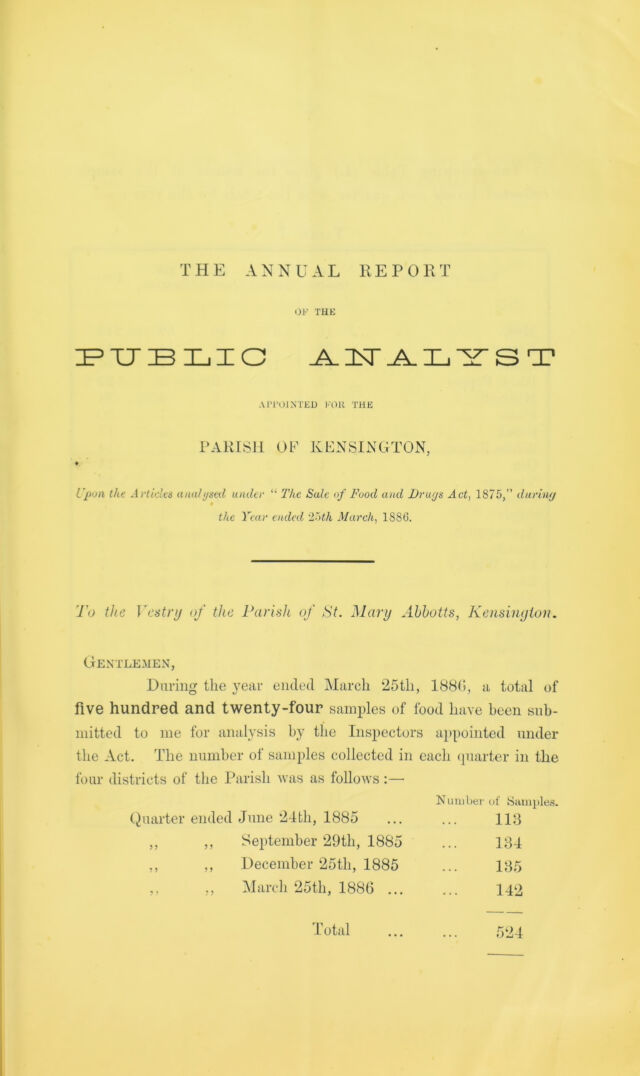
The annual report of the public analyst appointed for the parish of Kensington : upon the articles analysed under the Sale of Food and Drugs Act 1875, during the year ended 25th March 1886.
- Cassal, Charles E.
- Date:
- 1886
Licence: Public Domain Mark
Credit: The annual report of the public analyst appointed for the parish of Kensington : upon the articles analysed under the Sale of Food and Drugs Act 1875, during the year ended 25th March 1886. Source: Wellcome Collection.
Provider: This material has been provided by The Royal College of Surgeons of England. The original may be consulted at The Royal College of Surgeons of England.
15/16 page 15
![The sending of samples to Somerset House for analysis is another matter upon which it is very desirable that no miscon- ception should exist. Cases are dismissed occasionally when the Analysts at Somerset House do not feel themselves justilied m confirming the certificate of the Public Analyst upon which a prosecution has been ordered. This occurs, as a rule, with samples of Milk. The Inspector having purchased a sample of Milk, divides it in the presence of the vendor into three parts, which he seals up. One }>art lie leaves with the vendor, the second he submits to the Analyst, and the third he retains, should the Analyst certify that his sample is adulterated, until the case is heard, in order that it may be forwarded to Somerset House if the defendant desires it. Now, it will be observed, that some length of time must of necessity elapse before the Analysts at Somerset House can examine the sample submitted to them. In such a fiuid as milk, a certain amount of alteration must take place on keeping, and it is generally understood that the Somerset House Chemists make an allowance for the time that has passed between the selling of the sample and their analysis of it. That is to say, that an addition is made to some of the constituents of the milk, wliich is more or less great, according to the length of time, and which occasionally would a])pear to show that at the time of sale the milk could not be considered as adulterated. While venturing to differ with the Somerset House Analysts as to the certainty of their proceedings in this respect, in the majority of cases 1 am glad to acknowledge the cautious manner in which their c('rtifi- cates are worded when they do not feel themselves justified in confirming the I'esults of the Public Analyst:— After making allowance for the natural loss arising from the ilccom- position of the .Milk tliiougli keeping, the proportion of uoii-fatty solids is not lower than is found in genuine Milk. From a considera- tion of these results wc are unahh to afh’roi that tvatcr has been added to the iMilk.'' Another very i)otent ctiuse of discrepancy between the certi- ficates of Public Analysts and those of Somerset House is the difierence in the ‘'standards” adopted. The Somerset House](https://iiif.wellcomecollection.org/image/b2246881x_0017.jp2/full/800%2C/0/default.jpg)