Principles of human physiology : with their chief applications to psychology, pathology, therapeutics, hygiene, and forensic medicine / by William B. Carpenter.
- William Benjamin Carpenter
- Date:
- 1853
Licence: Public Domain Mark
Credit: Principles of human physiology : with their chief applications to psychology, pathology, therapeutics, hygiene, and forensic medicine / by William B. Carpenter. Source: Wellcome Collection.
Provider: This material has been provided by Royal College of Physicians, London. The original may be consulted at Royal College of Physicians, London.
26/1180
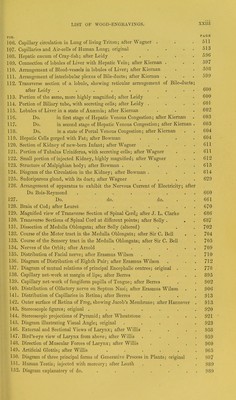
![EXPLANATION OP PLATES. riG. 10. Gravid uterus of a Woman who had committed suicide in the seventh week of preg- nancy, laid open ; a, os uteri internum ; 6, cavity of the cervix ; c, c, c, c, the four flaps of the body of the uterus turned back; d, d, d, inner surface of uterine decidual e,e, decidua reflexa external villous surface of the chorion; g, internal sur&ce of the chorion ; It, amnion ; i, umbilical vesicle ; k, umbilical cord ; I, embryo ; m, space between chorion and amnion {§§ 919-921, and 938, 939). [After Wagner ( Icones Physiologicae).] PLATE II. 11. Uterine Ovum of Rabbit, showing the Area Pellucida, with the primitive trace ($ 937). 12. More advanced ovum, showing the incipient formation of the Vertebral column, and the dilatation of the primitive groove at its anterior extremity {§ 937). 13. More advfinced embryo, seen on its ventral side, and showing the first development of the Circulating apparatus. Around the Vascular Area is shown the terminal sinus, a, a, a. The blood returns from this by two superior branches, b, h, and two infe- rior c, c, of the omphalo-meseraic veins, to the heart, d; which is, at this period, a tube curved on itself, and presenting the first indication of a division into cavities. The two aortic trunks appear, in the abdominal region, as the inferior vertebral arteries, e, e; from which are given off the omphalo-meseraic arteries,/^/, which form a network that distributes the blood over the vascular area. In the cephalic region are seen the anterior cerebral vesicles, with the two ocular vesicles g, (§§ 938, 940). [The three preceding figures are from the works of Bischoff previously cited,] PLATE III. (To face page 12). Comparative View of the Skeleton of Man, and that of the Orang Outan. [After Owen (Zoological Transactions, vol. i.).] LIST OF WOOD-ENGKAVINGS. PIG. PAGE 1. Comparative view of base of Skull of Man, and of Orang Outan ; after Owen . II 2. Fibrous structure of Inflammatory exudation ; after Gerber . . .31 3. Fibrous Membrane from Egg-shell ; original . . • . . 32 4. Cells from Chorda Dorsalis of Lamprey ; after Quekett . . .98 5. I-Isematococcus binalis, in various stages of development; after Hassall . . 103 6. Multiplication of Cartilage-cells by duplication ; after Leidy . . .104 7. Section of branchial cartilage of Tadpole; after Schwann . . . . 104 8. Endogenous Cell-growth in cells of a meliceritous tumour ; after Goodsir . 105 9. Cells with radiating fibres, from fluid of vesicles of Herpes ; after Addison . . 118 10. Red Corpuscles of Human blood ; after Donn6 . . . . .137](https://iiif.wellcomecollection.org/image/b24756994_0026.jp2/full/800%2C/0/default.jpg)



 No text description is available for this image
 No text description is available for this image
 No text description is available for this image