Principles and practice of crown and bridgework : a practical, systematic and modern treatise upon the requirements and technique of artificial crown and bridgework / By Hart J. Goslee.
- Goslee, Hart J., 1871-1930.
- Date:
- 1913
Licence: Public Domain Mark
Credit: Principles and practice of crown and bridgework : a practical, systematic and modern treatise upon the requirements and technique of artificial crown and bridgework / By Hart J. Goslee. Source: Wellcome Collection.
Provider: This material has been provided by the Augustus C. Long Health Sciences Library at Columbia University and Columbia University Libraries/Information Services, through the Medical Heritage Library. The original may be consulted at the the Augustus C. Long Health Sciences Library at Columbia University and Columbia University.
17/634 page 7
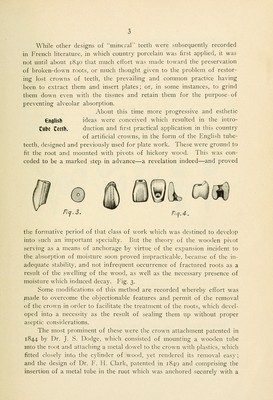
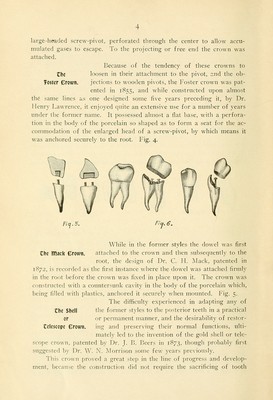
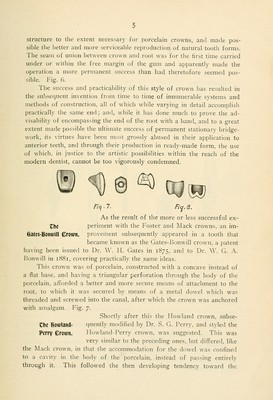
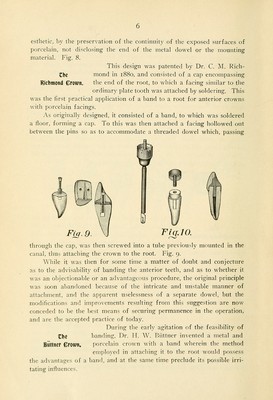
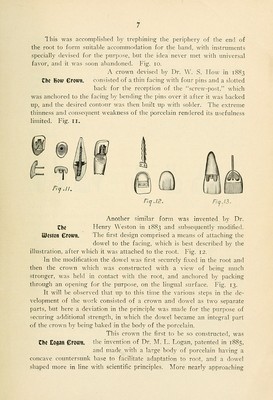
![This was accomplished by trephining the periphery of the end of the root to form suitable accommodation for the band, with instruments specially devised for the purpose, but the idea never met with universal favor, and it was soon abandoned. Fig. lo. A crown devised by Dr. W. S. How in 1883 the Bow Crown. consisted of a thin facing with four pins and a slotted back for the reception of the screw-post, which was anchored to the facing by bending the pins over it after it was backed up, and the desired contour was then built up with solder. The extreme thinness and consequent weakness of the porcelain rendered its usefulness limited. Fig. 11. f'q .11. Fiq.12. Fiq.13. Another similar form was invented by Dr. tbC Henry Weston in 1883 and subsequently modified. (Ueston Crown. The first design comprised a means of attaching the dowel to the facing, which is best described by the illustration, after which it was attached to the root. Fig. 12. In the modification the dowel was first securely fixed in the root and then the crown which was constructed with a view of being much stronger, was held in contact with the root, and anchored by packing through an opening for the purpose, on the lingual surface. Fig. 13. It will be observed that up to this time the various steps in the de- velopment of the work consisted of a crown and dowel as two separate parts, but here a deviation in the principle was made for the purpose of securing additional strength, in which the dowel became an integral part of the crown by being baked in the body of the porcelain. This crown the first to be so constructed, was CbC Cogan Crown, tlie invention of Dr. M. L. Logan, patented in 1885. and made with a large body of porcelain having a concave countersunk base to facilitate adaptation to root, and a dowel shaped more in line with scientific principles. ]\Iore nearly approaching](https://iiif.wellcomecollection.org/image/b21220943_0017.jp2/full/800%2C/0/default.jpg)

 No text description is available for this image
 No text description is available for this image
 No text description is available for this image