Principles and practice of crown and bridgework : a practical, systematic and modern treatise upon the requirements and technique of artificial crown and bridgework / By Hart J. Goslee.
- Goslee, Hart J., 1871-1930.
- Date:
- 1913
Licence: Public Domain Mark
Credit: Principles and practice of crown and bridgework : a practical, systematic and modern treatise upon the requirements and technique of artificial crown and bridgework / By Hart J. Goslee. Source: Wellcome Collection.
Provider: This material has been provided by the Augustus C. Long Health Sciences Library at Columbia University and Columbia University Libraries/Information Services, through the Medical Heritage Library. The original may be consulted at the the Augustus C. Long Health Sciences Library at Columbia University and Columbia University.
22/634 page 12
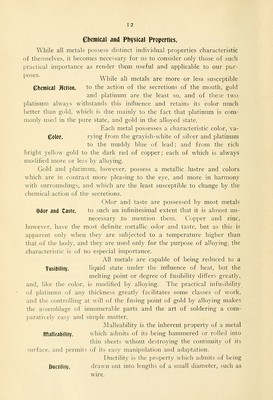
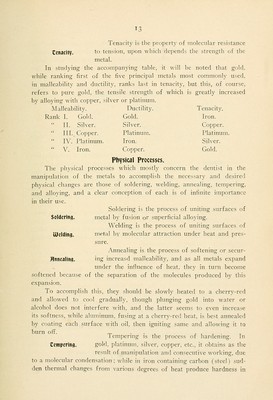
![CDcmicaJ and Pbysical Properties. While all metals possess distinct individual properties characteristic of themselves, it becomes necessary for us to consider only those of such practical importance as render them useful and applicable to our pur- While all metals are more or less susceptible Cbcmical Hction. to the action of the secretions of the mouth, gold and platinum are the least so, and of these two platinum always withstands this influence and retains its color much better than gold, which is due mainly to the fact that platinum is com- monly used in the pure state, and gold in the alloyed state. Each metal possesses a characteristic color, va- gOlor, rying from the grayish-white of silver and platinum to the muddy blue of lead; and from the rich bright yellow gold to the dark red of copper; each of which is always modified more or less by alloying. Gold and platinum, however, possess a metallic lustre and colors which are in contrast more pleasing to the eye, and more in harmony with surroundings, and which are the least susceptible to change by the chemical action of the secretions. Odor and taste are possessed by most metals Odor and taste. to such an infinitesimal extent that it is almost un- necessary .to mention them. Copper and zinc, however, have the most definite metallic odor and taste, but as this is apparent only when they are subjected to a temperature higher than that of the body, and they are used only for the purpose of alloying, the characteristic is of no especial importance. All metals are capable of being reduced to a Tuslbility. liquid state under the influence of heat, but the melting point or degree of fusibility differs greatly, and, like the color, is modified by alloying. The practical infusibility of platinum of any thickness greatly facilitates some classes of work, and the controlling at will of the fusing point of gold by alloying makes the assemblage of innumerable parts and the art of soldering a com- parati\-ely easy and simple matter. Malleability is the inherent property of a metal malleabHity. which admits of its being hammered or rolled into thin sheets wthout destroying the continuity of its surface, and permits of its easy manij:)ulation and ada])tation. Ductility is the proj^erty which admits of being Ductility. drawn out into lengths of a small diameter, such as wire,](https://iiif.wellcomecollection.org/image/b21220943_0022.jp2/full/800%2C/0/default.jpg)



 No text description is available for this image
 No text description is available for this image
 No text description is available for this image