Principles and practice of crown and bridgework : a practical, systematic and modern treatise upon the requirements and technique of artificial crown and bridgework / By Hart J. Goslee.
- Goslee, Hart J., 1871-1930.
- Date:
- 1913
Licence: Public Domain Mark
Credit: Principles and practice of crown and bridgework : a practical, systematic and modern treatise upon the requirements and technique of artificial crown and bridgework / By Hart J. Goslee. Source: Wellcome Collection.
Provider: This material has been provided by the Augustus C. Long Health Sciences Library at Columbia University and Columbia University Libraries/Information Services, through the Medical Heritage Library. The original may be consulted at the the Augustus C. Long Health Sciences Library at Columbia University and Columbia University.
29/634 page 19
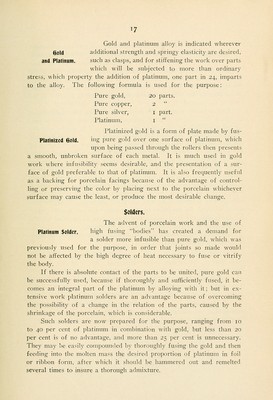
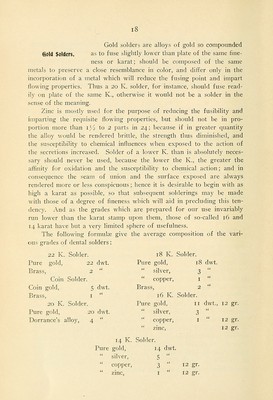
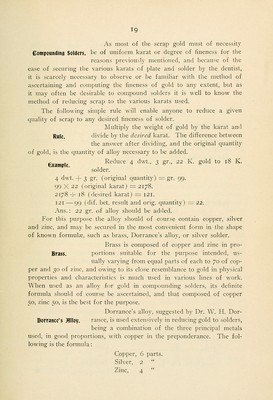
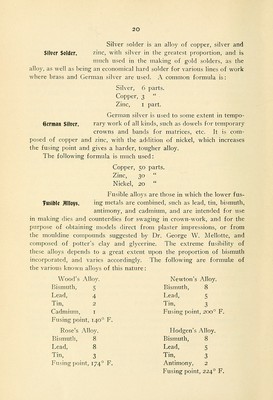
![As most of the scrap gold must of necessity Sompounding Solders, be of uniform karat or degree of fineness for the reasons previously mentioned, and because of the ease of securing the various karats of plate and solder by the dentist, it is scarcely necessary to observe or be familiar with the method of ascertaining and computing the fineness of gold to any extent, but as it may often be desirable to compound solders it is well to know the method of reducing scrap to the various karats used. The following simple rule will enable anyone to reduce a given quality of scrap to any desired fineness of solder. ]\Iultiply the weight of gold by the karat and |^Ul{, divide by the desired karat. The difference between the answer after dividing, and the original quantity of gold, is the quantity of alloy necessary to be added. P Reduce 4 dwt., 3 gr., 22 K. gold to 18 K. solder. 4 dwt. -f- 3 gr. (original quantity) = gr. 99. 99 X 22 (original karat) = 2178. 2178 H- 18 (desired karat) = 121. 121 —99 (dif. bet. result and orig. quantity) =: 22. Ans.: 22 gr. of alloy should be added. For this purpose the alloy should of course contain copper, silver and zinc, and may be secured in the most convenient form in the shape of known formulae, such as brass, Dorrance's alloy, or silver solder. Brass is composed of copper and zinc in pro- Bfa$$. portions suitable for the purpose intended, us- ually varying from equal parts of each to 70 of cop- per and 30 of zinc, and owing to its close resemblance to gold in physical properties and characteristics is much used in various lines of work. When used as an alloy for gold in compounding solders, its definite formula should of course be ascertained, and that composed of copper 50, zinc 50, is the best for the purpose. Dorrance's alloy, suggested by Dr. W. H. Dor- Dorrancc'S Jllloy. ranee, is used extensively in reducing gold to solders, being a combination of the three principal metals used, in good proportions, with copper in the preponderance. The fol- lowing is the formula: Copper, 6 parts. Silver, 2 Zinc, 4](https://iiif.wellcomecollection.org/image/b21220943_0029.jp2/full/800%2C/0/default.jpg)


 No text description is available for this image
 No text description is available for this image
 No text description is available for this image