The self-instructor in phrenology and physiology : with over one hundred new illustrations, including a chart for the use of practical phrenologists / By O. S. and L. N. Fowler. Rev. by Nelson Sizer.
- Orson S. Fowler
- Date:
- 1890 [1889]
Licence: Public Domain Mark
Credit: The self-instructor in phrenology and physiology : with over one hundred new illustrations, including a chart for the use of practical phrenologists / By O. S. and L. N. Fowler. Rev. by Nelson Sizer. Source: Wellcome Collection.
Provider: This material has been provided by the Harvey Cushing/John Hay Whitney Medical Library at Yale University, through the Medical Heritage Library. The original may be consulted at the Harvey Cushing/John Hay Whitney Medical Library at Yale University.
7/196
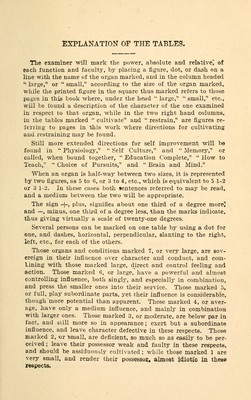
![EXPLANATION OF THE TABLES. The examiner will mark the power, absolute and relative^ of each function and faculty, by placing a figure, dot, or dash en a line with the name of the organ marked, and in the column headed * large, or small, according to the size of the organ marked, while the printed figure in the square thus marked refers to those pages in this book where, under the head large, small, etc., will he found a description of the character of the one examined in respect to that organ, while in the two right hand columns, in the tables marked cultivate and restrain, are figures re- ferring to pages in this work where directions for cultivating and restraining may be found. Still more extended directions for self improvement will be found in Physiology, Self Culture, and li Memory, or called, when bound together, Education Complete, How to Teach, Choice of Pursuits, and Brain and Mind. When an organ is half-way between two sizes, it is represented by two figures, as 5 to 6, or 3 to 4, etc., which is equivalent to 5 1-2 or 3 1-2. In these cases both sentences referred to may be read, and a medium between the two will be appropriate. The sign -]-, plus, signifies about one third of a degree more? and —, minus, one third of a degree less, than the marks indicate, thus giving virtually a scale of twenty-one degrees. Several persons can be marked on one table by using a dot for one, and dashes, horizontal, perpendicular, slanting to the right, left, etc., for each of the others. Those organs and conditions marked 7, or very large, are sov- ereign in their influence over character and conduct, and com- bining with those marked large, direct and control feeling and action. Those marked 6, or large, have a powerful and almost controlling influence, both singly, and especially in combination, and press the smaller ones into their service. Those marked 5, or full, play subordinate parts, yet their influence is considerable, though more potential than apparent. Those marked 4, or aver- age, have only a medium influence, and mainly in combination with larger ones. Those marked 3, or moderate, are below par in fact, and still more so in appearance; exert but a subordinate influence, and leave character defective in these respects. Those marked 2, or fcmall, are deficient, so much so as easily to be per- ceived ; leave their possessor weak and faulty in these respects, and should be assiduously cultivated; while those marked 1 are very small, and render their possessor, almost idiotic in these respects.](https://iiif.wellcomecollection.org/image/b2102425x_0007.jp2/full/800%2C/0/default.jpg)