The elements of thermal chemistry / by M.M. Pattison Muir ; assisted by David Muir Wilson.
- M. M. Pattison Muir
- Date:
- 1885
Licence: Public Domain Mark
Credit: The elements of thermal chemistry / by M.M. Pattison Muir ; assisted by David Muir Wilson. Source: Wellcome Collection.
38/338
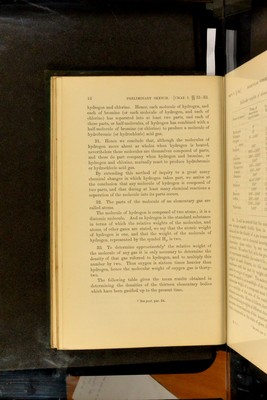
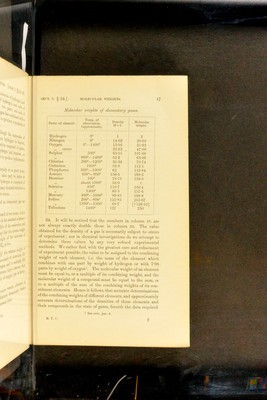
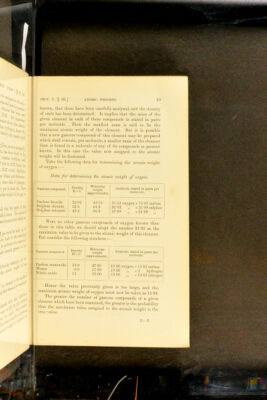
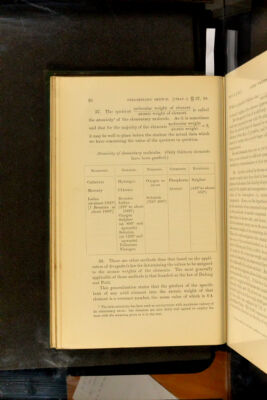
![- Iib=t. liyclrogcn and chlorine. Hence, each molecule of hydrogen, and each of bromine (or each molecule of hydrogen, and each of chlorine) has separated into at least two parts, and each of these parts, or half-molecules, of hydrogen has combined with a half-molecule of bromine (or chlorine) to produce a molecule of hydrobromic (or hydrochloric) acid gas. 31. Hence we conclude that, although the molecules of hydrogen move about as Avholes when hydrogen is heated, nevertheless these molecules are themselves composed of parts, and these do part company when hydrogen and bromine, or hydrogen and chlorine, mutually react to produce hydrobromic or hydrochloric acid gas. By extending this method of inquiry to a great many chemical changes in which hydrogen takes part, we arrive at the conclusion that any molecule of hydrogen is composed of two parts, and that during at least many chemical reactions a separation of the molecule into its parts occurs. 32. The parts of the molecule of an elementary gas are called atoms. The molecule of hydrogen is composed of two atoms; it is a diatomic molecule. And as hydrogen is the standard substance in terms of which the relative weights of the molecules, and atoms, of other gases are stated, we say that the atomic weight of hydrogen is one, and that the weight of the molecule of hydrogen, represented by the symbol H^., is two. 33. To determine approximately'^ the relative weight of the molecule of any gas it is only necessary to determine the density of that gas referred to hydrogen, and to multiply this number by two. Thus oxygen is sixteen times heavier than hydrogen, hence the molecular weight of oxygen gas is thirty- two. The following table gives the mean results obtained in determining the densities of the thirteen elementary bodies which have been gasified uj) to the present time. See post, par. 34. of P® Si “ CAiiw Arsenic gl'-UOO' lOOlf iiixr-iw m SMon Merrarr Teinriott m* II IKIC 8 W-lOflO* {I .W-40(l' 12 t] IW 12 tticedtliattlie dliedensitvof. in T** '‘“fctfci ^ **■ Of i \ JXti IS](https://iiif.wellcomecollection.org/image/b28065050_0038.jp2/full/800%2C/0/default.jpg)