Sight and touch : an attempt to disprove the received (or Berkeleian) theory of vision / by Thomas K. Abbott.
- Thomas Kingsmill Abbott
- Date:
- 1864
Licence: Public Domain Mark
Credit: Sight and touch : an attempt to disprove the received (or Berkeleian) theory of vision / by Thomas K. Abbott. Source: Wellcome Collection.
Provider: This material has been provided by the Francis A. Countway Library of Medicine, through the Medical Heritage Library. The original may be consulted at the Francis A. Countway Library of Medicine, Harvard Medical School.
99/196 page 87
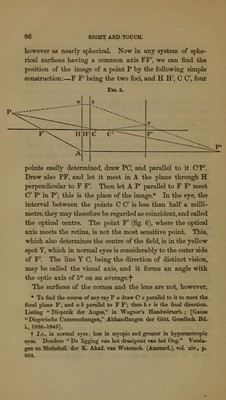
![COUKSE OF LIGHT IN THE EYE. Fia. 6. 87 spherical, but ellipsoidal, and therefore the refracted pencil is not collected into a point, but into a thin bundle of some length, or a focal line.* And further, as these surfaces are not generally symmetrical (or of revolution), they have a different focal length in the vertical and horizontal sections; so that the distances of distinct vision for horizontal and vertical lines are often sensibly different.-f- The bundle of rays is in fact towards one end broader in the vertical direc- tion, and towards the other in the horizontal. * See Sturm Comptes Rend., vol. xx. (1845), pp. 554, 761, 1238, where the form of the refracted pencil is investigated. It is owing to this that the eye has the appearance of achromatism, the focal intervals of rays of different refrangibility being partly superposed. f This astigmatism (which exists in most, if not all eyes) was first no- ticed by Young, Phil. Trans., 1801. cf. Plateau, Bullet, de l'Acad. de BruxeUes, 1834, p. 96. Helmholtz Physiol. Optik,pp. 140, 145. Fech- ner's Centralblatt, 1853, pp. 73, 96, 374, 558. Cornelius, Theorie des Sehens, p. 301. [Fick, Medicin. Physik., p. 328]. Wharton Jones, Proc. R.S., vol. x., p. 381. Procter, Philosoph. Magaz., vol. xxvl (1863), p. 295.](https://iiif.wellcomecollection.org/image/b21037930_0099.jp2/full/800%2C/0/default.jpg)