A report on amputations at the hip-joint in military surgery / by George A. Otis.
- George Alexander Otis
- Date:
- 1867
Licence: Public Domain Mark
Credit: A report on amputations at the hip-joint in military surgery / by George A. Otis. Source: Wellcome Collection.
27/110 page 25
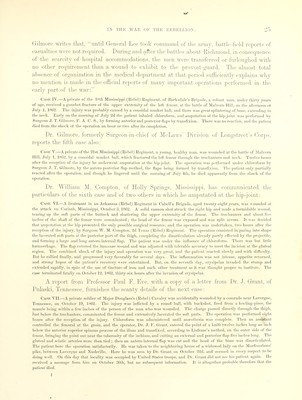
![Gilmore writes that, until General Lee took command of the army, battle field reports of casualties were not required. During and after the battles about Richmond, in consequence of the scarcity of hospital accommodations, the men were transferred or furloughed with no other requirement than a wound to exhibit to the provost-guard. The almost total absence of organization in the medical department at that period sufficiently explains why no mention is made in the official reports of many important operations performed in the; early part of the war: CASE IV.—A private of the 18th Mississippi (Rebel) Regiment, of Barksdale's Brigade, a robust man, under thirty years of age, received a gunshot fracture of the upper extremity of the left femur, at the battle of Malvern Hill, on the afternoon ot July 1, 1862. The injury was probahly caused by a conoidal musket ball, and there was great splintering of bone, extending to the neck. Early on the morning of July 2d the patient inhaled chloroform, and amputation at the hip-joint, was performed by Surgeon J. T. Gilmore, P. A. C. S., by forming anterior and posterior flaps by transfixion. There was no reaction, and the patient died from the shock of the operation an hour or two after its completion. Dr. Gilmore, formerly Surgeon-in-chief of McLaws' Division of Longstreet's Corps, reports the fifth case also: Case V.—A private of the 21st Mississippi (Rebel) Regiment, a young, healthy man, was wounded at the battle of Malvern Hill, July 1, 1862, by a conoidal musket ball, which fractured the left femur through the trochanters and neck. Twelve hours after the reception of the injury he underwent amputation at the hip-joint. The operation was performed under chloroform by Surgeon J. T. Gilmore, by the antero posterior flap method, the flaps being formed by transfixion. The patient only partially reacted after the operation, and though he lingered until the morning of July 4th, he died apparently from the shock of the operation. Dr. William M. Compton, of Holly Springs, Mississippi, has communicated the particulars of the sixth case and of two others in which he amputated at the hip-joint: Case VI.—A lieutenant in an Arkansas (Rebel) Regiment in Cabell's Brigade, aged twenty-eight years, was wounded at the attack on Corinth, Mississippi, October 3, 1862. A solid cannon-shot struck the right hip and made a formidable wound, tearing up the soft parts of the buttock and shattering the upper extremity of the femur. The trochanters and about five inches of the shaft of the femur were comminuted; the head of the femur was exposed and was split across. It was decided that amputation at the hi]) presented the only possible surgical resource, and the operation was undertaken, two hours after the reception of the injury, by Surgeon W. M. Compton, 2d Texas (Rebel) Regiment. The operation consisted in paring into shape the lacerated soft parts at the posterior part of the thigh, completing the disarticulation already partly effected by the projectile, and forming a large and long antero-internal flap. The patient was under the influence of chloroform. There was but little haemorrhage. The flap covered the immense wound and was adjusted with tolerable accuracy to meet the incision at the gluteal region. The combined shock of the injury and operation was very great, and the patient reacted slowly and with difficulty. But he rallied finally, and progressed very favorably for several days. The inflammation was not. intense, appetite returned, and strong hopes of the patient's recovery were entertained. But, on the seventh day, erysipelas invaded the stump and extended rapidly, in spite of the use of tincture of iron and such other treatment as it was thought proper to institute. The case terminated fatally on October 12, 1862, thirty-six hours after the invasion of erysipelas. A report from Professor Paul P. Eve, with a copy of a letter from Dr. J. Grant, of Pulaski, Tennessee, furnishes the scanty details of the next case: Case VII.—A private soldier of Major Douglass's (Rebel) Cavalry was accidentally wounded by a comrade near Lavergne, Tennessee, on October 19, 1862. The injury was inflicted by a round ball, with buckshot, fired from a fowling-piece, the muzzle being within a few inches of the person of the man who was wounded. The charge passed directly through the thigh, Just below the trochanters, comminuted the femur and extensively lacerated the soft parts. The operation was performed eight hours after the reception of the injury. Chloroform was administered until anaesthesia was complete. Then an assistant controlled the femoral at the groin, and the operator, Dr. J. F. Grant, entered the point of a knife twelve inches long an inch below the anterior superior spinous process of the ilium and transfixed, according to Lisfranc's method, on the outer side of the femur, bringing the point out near the tuberosity of the ischium, and cutting an external and posterior flap five inches long. The gluteal and sciatic arteries were then tied ; then an antero-internal flap was cut and the head of the bone was disarticulated. The patient bore the operation satisfactorily. He was taken to the neighboring house of a widowed lady on the Murfreesboro' pike, between Lavergne and Nashville. Here he was seen by Dr. Grant on October 22d, and seemed in every respect to be doing well. On this day that locality was occupied by United States troops, and Dr. Grant did not see his patient again. He received a message from him on October 30th, but no subsequent information. It is altogether probable therefore that the patient died.](https://iiif.wellcomecollection.org/image/b20422155_0027.jp2/full/800%2C/0/default.jpg)