A report on amputations at the hip-joint in military surgery / by George A. Otis.
- George Alexander Otis
- Date:
- 1867
Licence: Public Domain Mark
Credit: A report on amputations at the hip-joint in military surgery / by George A. Otis. Source: Wellcome Collection.
36/110 page 34
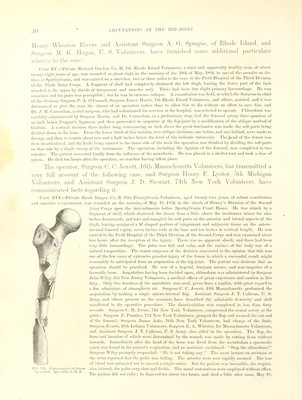
![Cask XXIII.—Private Henry H. Halo, Co. G, 14th Illinois Volunteers, twenty-one years of age, was wounded at the battle of Shiloh, April 6, 1862. A fragment of shell* shattered the upper portion of his left femur, so that fissures extended to the neck and far down the shaft. The soft parts on the outer aspect of the thigh were extensively lacerated and contused; the femoral vessels and nerves were uninjured. On April 9th, with four hundred and sixty other wounded brought from the field, he was placed on the hospital transport steamer Crescent City, to he conveyed to St. Louis. On April 12th, Brigade Surgeon D. P. Smith, U. S. Volunteers, assisted by Brigade Surgeons Thomas W. Fry and H. P. Stearns, U. S. Volunteers, and Assistant Surgeon M. C. Tolman, 2d Minnesota Volunteers, performed amputation at the hip-joint. The patient heing made insensible by chloroform, a long anterior Hap was made by transfixion. Surgeon Stearns, following the knife with his fingers, compressed the vessels in the flap, and completely controlled the haemorrhage. The head of the femur was rapidly disarticulated and the soft parts posteriorly were divided by a straight incision. The arteries of the posterior portion of the wound were first secured, and then those of the anterior flap. It was estimated by the operator that the bleeding did not exceed six ounces. The shock was slight and the patient reacted fairly, and for a short period after the operation the case wore an hopeful aspect. On April 14th, the hospital transport arrived at St. Louis, and the wounded were transferred to hospitals in that city. Shortly after Hale's admission to hospital his stump began to look badly, the vast wound suppurated profusely, gangrene supervened, and he sank and died, on April 20, 1802. A memorandum of the next case was published in Circular No. 6, 8. G. 0., 18(55, p. 50. Additional details respecting it have since been communicated by the operator, Professor George C. Black- man, of Cincinnati: ~j~ Case XXIV.—A private soldier of an Ohio regiment, about thirty-five years of age, was ' wounded on the first day of the battle of Shiloh, April 6, 1862, by a fragment of shell, which extensively comminuted the shaft, trochanters, and neck of the right femur, as illustrated in the accompanying wood-cut. The patient was left on the battle-field during the tempestuous night of April 6th, and until late on the following day. He was then removed to a temporary, hospital, and thence to the steamer Lancaster, to be transported to Cincinnati. On April Kith it was decided to remove the limb, and the patient being rendered insensible by chloroform, amputation at the hip-joint was performed by Brigade Surgeon G. C. Blackman, U. S. Volunteers, by the antero posterior flap method. The shock and haemorrhage were inconsiderable, and the patient rallied satisfactorily from the operation. On April 18th. the hospital transport arrived at Cincinnati, and the patient was transferred to St. John's Hospital in that city. Dr. C. D. Palmer, house-surgeon at St. John's, who was placed in charge of the case, reports that soon after the patient's admission to hospital the flaps began to slough badly, and that symptoms of pyaemia then supervened. Death ensued on April 22, 1862, six days from the date of operation. PIG, IX. Comminuted gunshot fracture of (lie femur. From a drawing furnished by Dr. The abstract of the next case was furnished by the operator, Biackman: ] )r J [' De Bruler, a highly esteemed practitioner of Evansville, Indiana, who, at the time, was an acting assistant surgeon in charge of the military hospital at that place: Case XXV.—Private Peter Pausbeck, Co. K, 43d Illinois Volunteers, was admitted on April 20, 1862, with nearly three hundred other wounded men from the battle-field of Shiloh, to Hospital No. 2, at Evansville. He had been wounded on April 7th, probably by a conoidal musket ball. The projectile had entered the front of the left thigh, about an inch below the level of the trochanter major, and ranging a little upwards had emerged from the gluteal region opposite. The upper portion of the femur « as crushed and almost powdered, and so extensive was the injury to the soft parts that some doubt was entertained as to the nature of the missile, several surgeons suggesting that it might have been a grape-shot. A consultation, at which the entire surgical staff of the hospital assisted, was held on the morning of April 21st, and every surgeon present concurred in the * In Circular No. 6, S. G. O., 1865, p. 50, it is stated that the wound was caused by canister-shot, on the authority of Surgeon John II. Brinton's careful report of the wounded at Shiloh. Dr. Smith states (Am. Med. Times, he. cit.) that a Minio ball inflicted the injury. Dr. Fry's account, copied from the original entry made at the time in his note-book, is most probably correct. t In the Cincinnati Journal of Medicine, Vol. I. p. 101, February, 1866, Dr. Blackman has indulged in some acrimonious reflections upon the value of the statistics of Circular No. 6, 1865, on the ground that the date of the fatal result in his amputa- tion at the hip-joint after Shiloh is erroneously reported in that circular. It is therefore proper to state that Dr. Blackman omitted to make a report of his operations after Shiloh, and that before the statement in Circular No. 6, the authority for which is there given, was published, three distinct applications were made to him for the particulars of his case, which applications wer e disregarded.](https://iiif.wellcomecollection.org/image/b20422155_0036.jp2/full/800%2C/0/default.jpg)