Housing : being the annotated texts of The Housing Act, 1957 and the Housing (Financial Provisions) Act, 1958 / by J.D. James.
- Great Britain
- Date:
- 1958
Licence: Public Domain Mark
Credit: Housing : being the annotated texts of The Housing Act, 1957 and the Housing (Financial Provisions) Act, 1958 / by J.D. James. Source: Wellcome Collection.
84/596 (page 56)
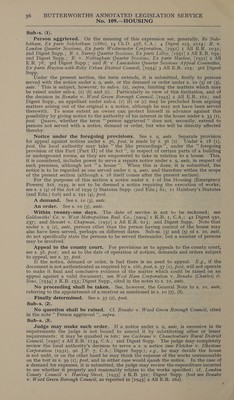
![No. 109.—HOUSING Sub-s. (1). Person aggrieved. On the meaning of this expression see, generally, Re Side- botham, Ex parte Sidebotham (1880), 14 Ch.D. 458, C.A.; 4 Digest 225, 2rr4; R. v. London Quarter Sessions, Ex parte Westminster Corporation, [1951] 1 All E.R. 1032; 2nd Digest Supp.; FR. v. Surrey Quarter Sessions, Ex parte Lilley, [1951] 2 All E.R. 659; 2nd Digest Supp.; R. v. Nottingham Quarter Sessions, Ex parte Harlow, [1952] 2 All E.R. 78; 3rd Digest Supp.; and FR. v. Lancashive Quarter Sessions Appeal Committee, Ex parte Huyton-with-Roby Urban District Council, [1954] 3 All E.R. 225; 3rd Digest Supp. Under the present section, the term extends, it is submitted, firstly to persons served with the notice under s. 9, ante, or the demand or order under s. Io (3) or (5), ante. This is subject, however, to sub-s. (2), supra, limiting the matters which may be raised under sub-s. (1) (b) and (c). Particularly in view of this limitation, and of the decision in Benabo v. Wood Green Borough Council, [1945] 2 All E.R. 162; 2nd Digest Supp., an appellant under sub-s. (1) (b) or (c) may be precluded from arguing matters arising out of the original s. 9 notice, although he may not have been served therewith. To some extent an owner can protect himself in advance against this possibility by giving notice to the authority of his interest in the house under s. 33 (1), post. Quaeve, whether the term “‘ person aggrieved ’’ does not, secondly, extend to persons not served with a notice, demand or order, but who will be directly affected thereby. Notice under the foregoing provisions. See s. 9, ante. Separate provision for appeal against notices under s. 36, post, is made by s. 36 (2). Under s. 18 (1), post, the local authority may take “‘ the like proceedings’’, under the “ foregoing provision of this Part [Part II] of the Act’’, in respect of certain parts of a building or underground rooms, as they are empowered to take in relation to a house. This, it is considered, includes power to serve a repairs notice under s. 9, ante, in respect of such premises, although not ‘“‘a house’’. When this is done, it is submitted, the notice is to be regarded as one served under s. 9, ante, and’therefore within the scope of the present section (although s. 18 itself comes after the present section). For the purposes of this section a notice under s. 1 of the Housing (Emergency Powers) Act, 1939, is not to be deemed a notice requiring the execution of works; see Ss. 2 (4) of the Act of 1939 (7 Statutes Supp. (2nd Edn.) 82; 11 Halsbury’s Statutes (2nd Edn.) 626) and s. 191 (4), post. A demand. Sees. 10 (3), ante. An order. Sees. 10 (5), ante. Within twenty-one days. The date of service is not to be reckoned; see Goldsmiths’ Co. v. West Metropolitan Rail. Co., [1904] 1 K.B. 1, C.A.; 42 Digest 950, 237; and Stewart v. Chapman, [1951] 2 All E.R. 613; 2nd Digest Supp. Note that under s. 9 (2), ante, persons other than the person having control of the house may also have been served, perhaps on different dates. Sub-ss. (3) and (5) of s. 10, ante, do not specifically state the persons to be served thereunder, but a number of persons may be involved. Appeal to the county court. For provisions as to appeals to the county court, see s. 38, post; and as to the date of operation of notices, demands and orders subject to appeal, see s. 37, post. If the notice, demand or order, is bad there is no need to appeal. £.g., if the document is not authenticated as required by s. 166, post, s. 37 (1), post, will not operate to make it final and conclusive evidence of the matter which could be raised on an appeal against a valid document; see West Ham Corporation v. Benabo (Charles) & Sons, [1934] 2 K.B. 253; Digest Supp., cited in the notes to s. Io, ante. No proceeding shall be taken. See, however, the General Note to s. 10, ante, referring to the appointment of a receiver as mentioned in s. Io (7), (8). Finally determined. See s. 37 (2), post. Sub-s. (2). No question shall be raised. Cf. Benabo v. Wood Green Borough Council, cited in the note “ Person aggrieved ’’, supra. Sub-s. (3). Judge may make such order. If a notice under s. 9, ante, is excessive in its requirements the judge is not bound to amend it by substituting other or lesser requirements; it may be quashed im toto; see Cochrane v. Chanctonbury Rural District Council, [1950] 2 All E.R. 1134, C.A.; 2nd Digest Supp. The judge may completely review the local authority’s decision to serve a s. 9 notice (see Fletcher v. Ilkestone Corporation (1931), 96 J.P. 7, C.A.; Digest Supp.); e.g., he may decide the house is not unfit, or on the other hand he may think the expense of the works unreasonable on the test in s. 39 (1), post, and in either case would quash the notice. In the case of a demand for expenses, it is submitted, the judge may review the expenditure incurred to see whether it properly and reasonably relates to the works specified; cf. London County Council v. Harling Street, [1935] 2 K.B. 322; Digest Supp. (but see Benabo v. Wood Green Borough Council, as reported in [1945] 2 All E.R. 162).](https://iiif.wellcomecollection.org/image/b32185844_0084.jp2/full/800%2C/0/default.jpg)