Volume 1
Principles and practice of medical genetics / edited by Alan E.H. Emery, David L. Rimoin ; associate editor, Jeffrey A. Sofaer ; editorial assistant, Isobel Black ; foreword by Victor A. McKusick.
- Date:
- 1990
Licence: Attribution-NonCommercial 4.0 International (CC BY-NC 4.0)
Credit: Principles and practice of medical genetics / edited by Alan E.H. Emery, David L. Rimoin ; associate editor, Jeffrey A. Sofaer ; editorial assistant, Isobel Black ; foreword by Victor A. McKusick. Source: Wellcome Collection.
140/976 (page 112)
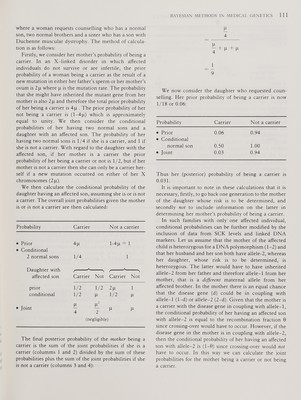
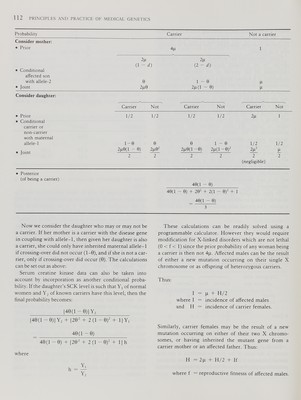
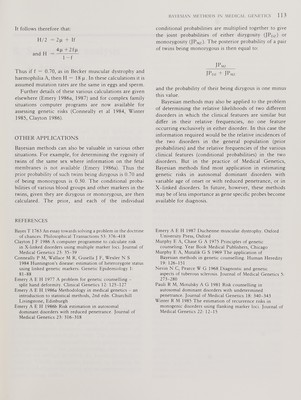
![Probability Carrier Not a carrier Consider mother: • Prior 4p 1 2 P 2 p (1 - d) (2 - d) • Conditional affected son with allele -2 e 1 - 0 P • Joint 2 p 0 2 p(l - 0 ) P Consider daughter: Carrier Not Carrier Not Carrier Not • Prior • Conditional 1/2 1/2 1/2 1/2 2 p 1 carrier or non-carrier with maternal allele -1 i-e e 0 1-0 1/2 1/2 • Joint 2 p 0 (l - 0 ) 2p9 2 2 p 0 (l — 0 ) 2 p(l — 0) 2 № £ 2 2 2 2 2 2 (negligible) • Posterior (of being a carrier) 40(1 - 0) 40(1 - 0 ) + 20 2 + 2(1 - 0) 2 + 1 40(1 - 0) 3 Now we consider the daughter who may or may not be a carrier. If her mother is a carrier with the disease gene in coupling with allele-1, then given her daughter is also a carrier, she could only have inherited maternal allele-1 if crossing-over did not occur (1 -0), and if she is not a car rier, only if crossing-over did occur (0). The calculations can be set out as above: Serum creatine kinase data can also be taken into account by incorporation as another conditional proba bility. If the daughter’s SCK level is such that Y, of normal women and Y, of known carriers have this level, then the final probability becomes: [40(1 ~0)]Y 2 [40(1 - 0)] Y 2 + [20 2 + 2 (1 - 0) 2 + 1] Y, _ 40(1-0) 40(1 - 0) + [20 2 + 2 (1 - 0) 2 + 1] h where These calculations can be readily solved using a programmable calculator. However they would require modification for X-linked disorders which are not lethal (0 < f < 1) since the prior probability of any woman being a carrier is then not 4p. Affected males can be the result of either a new mutation occurring on their single X chromosome or as offspring of heterozygous carriers. Thus: I = p + H/2 where I = incidence of affected males and H = incidence of carrier females. Similarly, carrier females may be the result of a new mutation occurring on either of their two X chromo somes, or having inherited the mutant gene from a carrier mother or an affected father. Thus: H = 2p + H/2 + If where f = reproductive fitnesss of affected males.](https://iiif.wellcomecollection.org/image/b18037434_vol_1_0141.JP2/full/800%2C/0/default.jpg)