Volume 1
Principles and practice of medical genetics / edited by Alan E.H. Emery, David L. Rimoin ; associate editor, Jeffrey A. Sofaer ; editorial assistant, Isobel Black ; foreword by Victor A. McKusick.
- Date:
- 1990
Licence: Attribution-NonCommercial 4.0 International (CC BY-NC 4.0)
Credit: Principles and practice of medical genetics / edited by Alan E.H. Emery, David L. Rimoin ; associate editor, Jeffrey A. Sofaer ; editorial assistant, Isobel Black ; foreword by Victor A. McKusick. Source: Wellcome Collection.
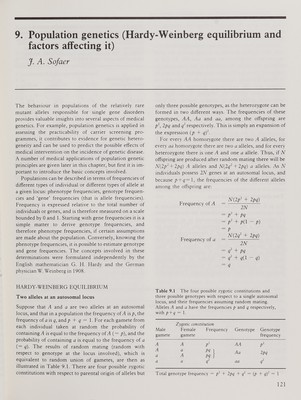
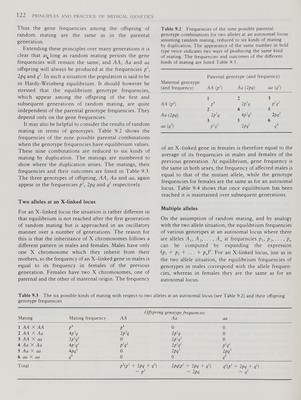
145/976 (page 117)
![Table 8.1 Estimation of segregation ratio among complete ascertainment families with three offspring of normal parents 8.1 A Expected distributions of families and offspring Index for Population sample Type of family Expected Ascertained sample Expected Number Corrected number family (by distribution of frequency frequency of of offspring of offspring type (i) trait among of family type family type NF(i) = SNU(i) = SNA(i) = CNU(i) = CNA(i) = offspring) number of families number number unaffected affected number number unaffected affected 0 3 unaffected 27/64 0 0 0 0 0 0 1 2 unaffected 1 affected 27/64 27/37 27 54 27 54 0 2 1 unaffected 2 affected 9/64 9/37 9 9 18 18 18 3 3 affected 1/64 1/37 1 0 3 0 6 Total: 1 1 37 63 48 72 24 heterozygous parents produce at least one affected child. Failure to ascertain families with no affected children distorts the sample and, without ascertainment correc tion, the number affected will appear to be greater than expected, and the recessive mode of inheritance may be mistakenly rejected. The degree of distortion in the data and a method to correct the ascertainment bias depends on the investiga tor’s choice of the ascertainment scheme when planning the study. This decision defines who may be a proband, and the definition must be rigorously subscribed to throughout the study. Variable ascertainment criteria create a situation where no one correction method is appropriate and analysis may lead to false rejection or acceptance of the hypothesis. The examples in the next two sections will serve to illustrate the extremes of the selection choices, before describing a general approach. COMPLETE ASCERTAINMENT When the search for probands is carried out for an extended period of time, and with many sources of ascertainment, all of the affected individuals within the study areas will be identified. Under this complete ascertainment sampling every affected individual in the sample is independently ascertained, i.e. found through a study source not only identified by interview of family members. The probability that a family is included in the study is independent of the number of affected indivi duals in the family. The distribution of affected members in the family for a genetic trait is exactly that described by the Mendelian ratio, with the exception that there are no families with all normal children. Weinberg (1928) described the ascertainment bias and proposed the pro band method for correcting for this bias (see Table 8.1). The principle is simple: one discards a proband and counts the number of remaining affected and unaffected sibs, repeating the step for each proband. Table 8.1 reveals the serious distortion in the ratio before the correction, the exact 3:1 ratio after the correction, and summarizes the procedure. SINGLE ASCERTAINMENT A common alternative to complete ascertainment is to choose one group for sampling, for example testing all second grade school children for hearing deficits and defining deaf children as probands. Under single ascer tainment sampling every family has only one proband. The sample which results, like that of complete ascer tainment, will contain only families with at least one affected member, but now the chance that a family is Table 8.IB Estimation of segregation ratio Uncorrected segregation ratio SNU(T):SNA(T) = 63:48 = 7:8 Corrected segregation ratio CNU(T):CNA(T) = 72:24 = 3:1 3 Where: CNA(T) = Y CNA(i) i= 1 3 CNU(T) = V CNU(i) i — I CNU(i) = i X SNU(i) CNA(i) = [SNA(i) - NF(i)] X i](https://iiif.wellcomecollection.org/image/b18037434_vol_1_0146.JP2/full/800%2C/0/default.jpg)