Census of England & Wales, 1931 : general report.
- General Register Office Northern Ireland
- Date:
- 1950
Licence: Public Domain Mark
Credit: Census of England & Wales, 1931 : general report. Source: Wellcome Collection.
163/216 page 151
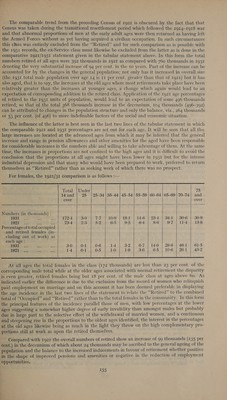
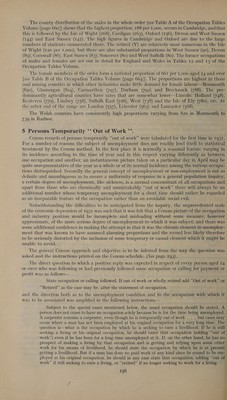
![proportion of 24 per 1,000 of 14 years and over, range from 15 in Lincoln, Holland, 16 in Stafford and the Isle of Ely and 17 in Durham to 36 in Cardigan, 38 in Cambridge and Hertford, 39 in Middlesex and 47 in Surrey. Professional women form the same average proportion as men (24 per 1,000), but have a rather narrower range, from 17 in Lincoln, Holland, 18 in the Isle of Ely and 19 in Durham, Leicester, Stafford and the West Riding of Yorkshire to 31 in Berkshire, 32 in Surrey, 33 in Oxford and West Sussex, and 36 in East Sussex. Since 36 per cent. of these women are nurses (including midwives and mental attendants), and a further 51 per cent. are teachers (including music teachers) a more restricted range than that of men is to be expected. For both men and women the occupation which has the largest number of members is that of teaching. Male teachers (800, 801) number 84,346 and form a national proportion of 6 per 1,000 over 14. In the counties (see Table A of the Occupation Tables Volume [page 663]) the highest proportions are in Cambridge (14), Oxford (12), Caernarvon (10) and Cardigan (14); the lowest are in Bedford, the Isle of Ely, Lincoln, Holland and the Soke of Peterborough (4 each). The average proportion in Wales is somewhat higher than that in England. The proportion of female teachers (800, 801), which, on the average is 12, ranges from 9 in London to 18 in Huntingdon, Oxford and Brecknock. The members of the other large female profession, sick nursing (794), are relatively most common in East Sussex (15 per 1,000), West Sussex (12), London (11) and Berkshire, Southampton, Surrey, the Isle of Wight and Denbigh (10 each). Order X XVI. Persons Professionally engaged in Entertainments and Sport from a comp- aratively small order, but one that has increased considerably since 1921. Its male members, as a whole, have increased by 45 per cent., and its female members by 13 per cent., the numbers being 91,654 and 22,369 respectively in 1931. Of the several occupations distinguished, noteworthy increases occur among bookmakers (839), the males by more than threefold and the females by more than fivefold; proprietors and managers of other entertainments and sports (834)—males 95 per cent., females 48 per cent.; stage hands, etc., (837)—males 73 per cent.; and film producers etc., (832)—males 64 per cent., females 136 per cent. Actors show very little change in numbers for either sex. Decreases are recorded for male theatrical agents etc. (831)—32 per cent.; showmen, etc., (833)—males 8 per cent., females 31 per cent. and male race horse trainers, etc., (838)—28 per cent. The numbers shown under the last named heading are not precisely comparable for 1921 and 1931, grooms having been excluded in 1931. Reference to the Industry Tables, (page 719), shows an increase of about 21 per cent. in the corresponding industry (1I:753) (on the assumption that any contribution made by dog-racing and coursing to the 1921 figure was negligible). The county distribution provided by Table A of the Occupation Tables Volume [page 667} shows that the male members of the order are 6 per 1,000 in England and Wales, 11 in West Suffolk and East Sussex, Io in Berkshire and London, but only 2 in Lincoln, Holland and Cardigan, Race horse trainers, etc. (838) form proportions of 7 per 1,000 in West Suffolk, 3 in Berkshire and Wiltshire and 1 in Cambridge, Surrey, Sussex and the North Riding of Yorkshire; these counties together accounting for two-thirds of the national total of 2,360. Order XXVII. Persons Engaged in Personal Service (including Institutions, Clubs, Hotels, etc.) (850-879). Greater numbers of occupied persons are assigned to this group than to any other single order but the number of males, 462,935, while itself considerable, was outnumbered by the females, 1,926,978, by more than four to one. Indeed, among occupied females this order contains more than three times as many as any other. The largest individual occupation in the group is, of course, that of indoor domestic servants (850) which includes 17 per cent. of the males and 69 per cent. of the females, the next largest among males being inn and hotel keepers, etc., (864) with 15 per cent. and among females, char- women, office cleaners (874) with 7 per cent. The numbers in the order have increased since 1921 by 36 per cent. among males and 15 per cent. among females. Every male occupation shows an increase except inn and hotel keepers, etc., (864) the greatest among those with ten thousand or more employed being hall and hotel porters, etc., (869) with 136 per cent. and carpet beaters, etc., (875) with 119 per cent. Male domestic servants increased by 29 per cent. The only decreases in females occurred among inn and hotel keepers etc., as in the case of males, and among lodging and boarding house keepers (862), the numbers in the former falling by 39 per cent. and in the latter by 37 per cent. Female domestic servants increased by 16 per cent. and hairdressers, manicurists, etc. (872) showed a remarkabl : increase from 5,843 in 1921 to 33,636, nearly 6 times as many. The distribution throughout the counties shows considerable variation, ranging as might be expected, from low proportions in industrial areas to high ones in the more wealthy and mainly residential counties. For females the distribution is governed by and closely follows that of domestic servants. Males with an average of 32 per 1,000 aged 14 and over range from 16 in Monmouth to 66 in London whilst females with an average of 117 range from 73 in Leicester to I5I](https://iiif.wellcomecollection.org/image/b32183203_0163.jp2/full/800%2C/0/default.jpg)
 No text description is available for this image
 No text description is available for this image
 No text description is available for this image