Census of England & Wales, 1931 : general report.
- General Register Office Northern Ireland
- Date:
- 1950
Licence: Public Domain Mark
Credit: Census of England & Wales, 1931 : general report. Source: Wellcome Collection.
175/216 page 163
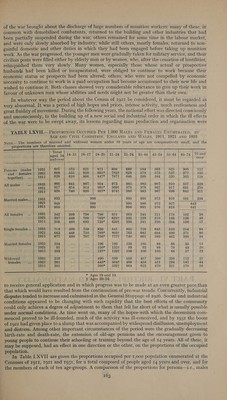
![of the war brought about the discharge of large numbers of munition workers: many of these, in common with demobilised combatants, returned to the building and other industries that had been partially suspended during the war; others remained for some time in the labour market, and were only slowly absorbed by industry; while still others, mostly females, returned to non- gainful domestic and other duties in which they had been engaged before taking up munition work. As the war progressed, the younger men were gradually taken for military service, and their civilian posts were filled either by elderly men or by women, who, after the cessation of hostilities, relinquished them very slowly. Many women, especially those whose actual or prospective husbands had been killed or incapacitated, were obliged to continue to work because their economic status or prospects had been altered; others, who were not compelled by economic necessity to continue to work in a paid occupation had become accustomed to their new life and wished to continue it. Both classes showed very considerable reluctance to give up their work in favour of unknown men whose abilities and needs might not be greater than their own. In whatever way the period about the Census of 1g21 be considered, it must be regarded as very abnormal. It was a period of high hopes and prices, intense activity, much restlessness and great fluidity of movement. During the following years, the national effort was directed consciously and unconsciously, to the building up of a new social and industrial order in which the ill effects of the war were to be swept away, its lessons regarding mass production and organisation were TABLE LXVII.—Proportions OccuPIED PER 1,000 MALES AND FEMALES ENUMERATED, BY AGE AND CIVIL CONDITION, ENGLAND AND WALES, 1911, 1921 AND 1931 Note.—The numbers of married and widowed women under 18 years of age are comparatively small, and the proportions are therefore omitted. EE _—————OC oOo | Total aged 14| 14-15 | 16-17 | 18-20 | 21-24 | 25-34 | 35-44 | 45-54 | 55-64 | 65-74 | 75 and andover| — over Persons (males } 1931 | 607 | 575 | 821 | 871 | 808 | 660 | 584] 563 | 525 | 308 | 119 and females} 1921 | 608 | 551 | 810 | 861* |, 782¢ | 628 | 579 | 575 |. 587 |«377 | 132 together) ...| 1911 | 628 | 610 | 806 | 847*| 787+ | 646 | 599 | 584 | 530 | 363.| 158 Allmales «.. | 2981 | 905 | 641 | 887.| 954 | 973 | 985 | 982 | 967 | 910 | 557 | 228 3 1921 | 917 | 654 | 914 | 965*| 969+ | 978 | 978 | 967 | 917 | 691 | 270 i911 | 926 | 740 | 920 | 957* | 974+] 986 | 983 | 967 | 896 | 645 | 311 ee ee ie | 933 996 995 | 990 | 975 | 919 | 581 | 256_ 1921 | 949 988 990 | 986 | 975 | 927 643 1911 955 995 996 | 991 976 918 641 Allfemales ...| 1931 | 342 | 509 | 756 | 790 | 651 | 363 | 245 | 211 | 178 | loz | 38 1921 | 337} 448 | 709 | 763 | 622+] 335 | 229 | 210 | 193 | 126 | 46 1911 | 356 | 480 | 693 | 739*| 620; | 338 | 241 | 230 | 204 | 138 | 57 Single females... | 1931 | 719 | 509 | 759 | 830 | 841 | 805 | 728 | 645 | 510 | 254 | 88 1921 | 683. | 448 | 710 | 789*| sost| 763 | 682 | 604 | 490 | 271 | 86 1911 | 677 | 480 | 707 | 756*| 777+ | 740 | 661 | 589 | 462 | 260 | 94 Married females | 1931 | 104 | — | — | 196 | 193 | 138 | 105 | 88 |. 66 | 33 |, 12 1921 | 91 Sew e Siggm teat fos OG. 98) be BB LP 76h, age | | 20 TOU POOR oS} a)) S24 eager! Ta29¢'4 e106 |} oes) |! 168') bP o-eeeE}! BT:/ 4 98 Widowed 1931 | 216 | — | | 490 | 599 | 556 | 457 | 360 |. 256,| 113 | 35 females ... | 1921 | 261 2 |) — | 445*| 5044 | 468° | 458 | 411 | 294 | 147-}) 44 i911 | 301 ao) = | b00e)| ceo} || 664 | 623) | 470 | 321/170 |. 58 * Ages 18 and 19. ¢ Ages 20-24. to receive general application and in which progress was to be made at an even greater pace than that which would have resulted from the continuation of pre-war trends. Concurrently, industrial disputes tended to increase and culminated in the General Stoppage of 1926. Social and industrial conditions appeared to be changing with such rapidity that the best efforts of the community could only achieve a degree of adjustment to them that fell far short of what is usually possible under normal conditions. As time went on, many of the hopes: with which the decennium com- menced proved to be ill-founded, much of the activity was ill-conceived, and by 1931 the boom of 1921 had given place to a slump that was accompanied by widespread disillusion, unemployment and distress. Among other important circumstances of the period were the gradually decreasing birth-rate and death-rate, the extension of old-age pensions and the encouragement given to young people to continue their schooling or training beyond the age of 14 years. All of these, it may be supposed, had an effect in one direction or the other, on the proportions of the occupied population. ’ In Table LXVII are given the proportions occupied per 1,000 population enumerated at the Censuses of I9II, 1921 and 1931, for a total composed of people aged 14 years and over, and for the members of each of ten age-groups. A comparison of the proportions for persons—i.e., males](https://iiif.wellcomecollection.org/image/b32183203_0175.jp2/full/800%2C/0/default.jpg)


 No text description is available for this image
 No text description is available for this image
 No text description is available for this image