New elements of operative surgery / by Alf. A.L.M. Velpeau, carefully revised, entirely remodelled, and augmented with a treatise on minor surgery ; illustrated by over 300 engravings, incorporated with the text, accompanied with an atlas in quarto of twenty-two plates, representing the principal operative processes, surgical instruments ; translated by P.S. Townsend. Augmented by the addition of several hundred pages of entirely new matter, comprising all the latest improvements and discoveries in surgery, in America and Europe, up to the present time. Under the supervision of, and with notes and observations by Valentine Moth.
- Alfred-Armand-Louis-Marie Velpeau
- Date:
- 1845-1847
Licence: Public Domain Mark
Credit: New elements of operative surgery / by Alf. A.L.M. Velpeau, carefully revised, entirely remodelled, and augmented with a treatise on minor surgery ; illustrated by over 300 engravings, incorporated with the text, accompanied with an atlas in quarto of twenty-two plates, representing the principal operative processes, surgical instruments ; translated by P.S. Townsend. Augmented by the addition of several hundred pages of entirely new matter, comprising all the latest improvements and discoveries in surgery, in America and Europe, up to the present time. Under the supervision of, and with notes and observations by Valentine Moth. Source: Wellcome Collection.
Provider: This material has been provided by the Woodruff Health Sciences Center Library at Emory University, through the Medical Heritage Library. The original may be consulted at the Woodruff Health Sciences Center Library, Emory University.
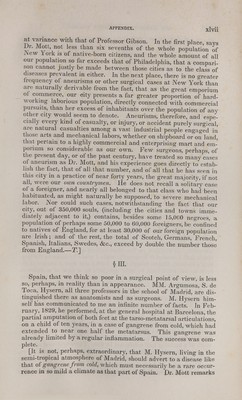
![days, followed by adhesive straps, bringing the flesh well and firmly in every part over the ends of the bones, which, with tonic treat- ment internally, rapidly completed the cure. Emollient poulticing is undoubtedly proper in the onset of the disease, (which resembles that of a severe blister,) to allay the acute and often agonizing pain of the inflammation, and to promote the sloughing of the parts which follows; but nothing is more injudicious than to continue this practice beyond the time when the line of demarcation of the gangrene is clearly established.—T.] A. Towards the month of September, of the same year, says M. Hysern, I practised, for the first time, blepharoplasty on a girl of twenty years, to restore a loss of substance of the external half of the two eyelids of the left eye. I employed a method which is mine, and which I have called temporo-facial. The success was complete. In July, 1833, I practised anew the temporo-facial blepharo- plasty, to restore the totality of the inferior eyelid which I previous- ly extirpated at the same sitting, in consequence of a nsevus ma- ternus which had invaded that and the conjunctiva of the ball, up to the lower half*of the base of the cornea. The result was suf- ficiently satisfactory; the new lid perfectly shut the eye with the upper, which had its movements free. B. In August, 1833, I performed rhinoplasty by the Indian method, on a man forty-eight years of age, from whom I had extir- pated a cancerous tumor that affected the nose,, the nasal notch of the left superior maxillary, and almost the entire pyramidal bone of that side, extending below to the upper third of the upper lip. The operation succeeded. The enormous wound of the face was reduced to a crucial cicatrix of an inch and a half in length in its transverse branch, less than an inch in its vertical, of two to three lines in breadth throughout almost its whole extent, and of four to six lines in the centre, that is to say, at the crossing of the branches. In September, 1837,1 practised another rhinoplasty by the Italian method, that is to say, in place of taking the patch at hazard on the limb, I procured it from the place where there are more nerves and cutaneous vessels; that is, from the anterior and external part of the arm, near the bend of the elbow, and over, the course of the branches of the radial nerve and the profunda. The patch was adherent in more than three quarters of its periphery. Fifteen days after, I cut off the base of it; but in spite of every possible precaution, gangrene commenced, except on one inch of its upper part, which kept in place and preserved its vitality. In the month of October following, I practised another rhino- plasty by the Indian method, and with success. To hold the new nose, I employed advantageously a framework of cork, divided verti- cally into three parts, in the manner of the forms that hatters use. C. In March, 1835,1 performed, on a girl of five years, the ex- tirpation of a lupus (loupe) of the size of a pullet's egg, having its seat in the middle of the upper part of the forehead, on the hairy scalp. This lupus had eroded the bones, and was adherent to the G](https://iiif.wellcomecollection.org/image/b21036767_0054.jp2/full/800%2C/0/default.jpg)