Geology of the lower Amazon region / Charles Schuchert.
- Charles Schuchert
- Date:
- [1906]
Licence: In copyright
Credit: Geology of the lower Amazon region / Charles Schuchert. Source: Wellcome Collection.
Provider: This material has been provided by The Royal College of Surgeons of England. The original may be consulted at The Royal College of Surgeons of England.
10/28 page 728
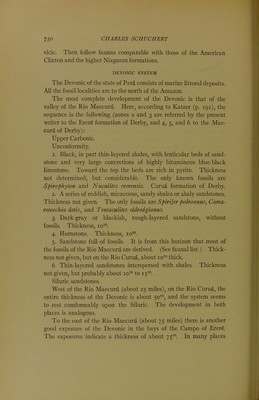
![In the valley of the Trombetas this series rests unconformably upon felsite or eurite (6:145). It consists almost exclusively of hard argillaceous and micaceous [variously colored, white, yellow, red, and purple] sandstones, generally thin bedded, but with some massive beds of pure sandstone One set of beds of cherty schist, about 20 feet thick, is found at the base of the series, in contact with syenite Just above the cherty rocks there is a bed of fine-grained, yellowish sandstone contain- ing a few fossils (6:168). These fossils, according to Clarke (5), are of the following species, restricted to Brazil: Lingulops derbyi, Orbiculoidea hartti, Pholidops irombeiana, Orlhis callactis amazonica^ Dalmanella freilana, D. smithi, Chonetes cf. novascoticus^ Anabia paraia, Anodontopsis putilla, A. austrina, Tellinomya pulchella, T. subrecla, Clidophorus brazil- ianus, Bucaniella trilobata viromundo, Tentaculites irombetensis, Conularia amazonica, Primitia minuta, Bollia lata brasiliensis. In higher beds occurs Arthrophycus alleghaniensis. Clarke (5) regards this fauna as transitional between Ordovicic and Siluric or Middle Siluric, but quite different from that of the island of Anticosti. Derby (6:168) states that it indicates “a close correspondence with the Medina sandstone.” Katzer refers it to the lower portion of the Siluric. The correlations of these authors are harmonious, but the question is raised: What is meant by transitional between Ordovicic and Sil- uric? In other words, is the Brazilian Siluric fauna comparable with the Medina of the Appalachian region or with the Middle Siluric of Anticosti? Nothing definite can be said in regard to Anticosti Divisions i and 2, as these faunas need to be restudied in the fight of modem knowledge. In regard to the Medina no new reading could be given, were it not for considerable evidence gathered by Ulrich in the Mississippi vaUey from Iowa south into Arkansas, and as yet unpublished. Underlying unmistakable Clinton faunas of the Interior type (Dayton, Ohio) he has found a zone usually quite thin and intimately connected with the highest Ordovicic or the uppermost Richmond member of the Cincinnatian division. In this zone, near Edgewood, Mo., Ulrich has collected a Stromatoporoid of Silmic character, Zaphrentis n. sp., Favosites near as per, Calapoecia canadensis, Tentaculites incurvus, Dalmanella of the meeki or jugosa](https://iiif.wellcomecollection.org/image/b22407066_0012.jp2/full/800%2C/0/default.jpg)


 No text description is available for this image
 No text description is available for this image
 No text description is available for this image