The elements of materia medica and therapeutics (Volume 2).
- Jonathan Pereira
- Date:
- 1852-1854
Licence: Public Domain Mark
Credit: The elements of materia medica and therapeutics (Volume 2). Source: Wellcome Collection.
Provider: This material has been provided by the National Library of Medicine (U.S.), through the Medical Heritage Library. The original may be consulted at the National Library of Medicine (U.S.)
66/1226
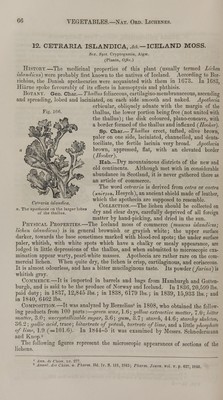
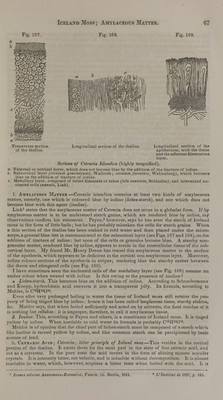
![soluble in boiling alcohol, but crystallizes in great part on cooling. It is slightly soluble in ether, and is quite insoluble in the fixed and volatile oils. Its formula is C34H16015. It is dissolved both by the caustic and carbonated alkalies, and is precipitated from its solution by acids. Ce- trarale of ammonia (2NH3,C34H16015) is a beautiful yellow salt, having a faint ammoniaca] odour, and being soluble in water. By exposure to the air it gradually becomes brown. Schnedermann explains the production of the brown colour of Iceland moss by supposing that the cetraric acid of the thallus absorbs atmospheric ammonia, and the cetrarate of ammonia thus formed becomes brown by exposure to the air. The alkaline cetrarates yield a red colour (cetrarate of iron) with the salts of the peroxide of iron. Now as the ashes of Iceland moss contain iron, Schnedermann thinks it not improbable that the red spots which are sometimes found at the base of the lichen may be due to the presence of cetrarate of iron, produced by the action of cetrarate of ammonia (formed as above explained) on the ferruginous constituent. Cetrarate of lead (2PbO,C34Hl6015) forms a yellow flocculent precipitate. 3. Lichesteahic Acid (so called from Xfi^nv, lichen; and e-rlap, fat). When pure it is per- fectly white, and consists of pearly crystalline plates. It is odourless, but has an acrid taste. It is soluble in alcohol, ether, and the volatile and fatty oils, but is insoluble in water. At 248° F. it melts, and on cooling congeals into a crystalline mass. It cannot be volatilized without de- composition. Its formula is C29H2505. It is dissolved by alkalies, and is precipitated from its alkaline solution by acids. Lichestearate of potash is a white indistinctly crystalline powder: Licheslearate of silver (AgO,C29H2405) is grayish white: Lichestearate of lead (PbO,C24H2*06) is white: Lichestearate of baryta is grayish white: Lichestearate of ammonia is crystallizable. 4. Fumahic Acid; Lichenic acid.—This acid was discovered in Iceland moss by Pfaff. 5. A neutral substance, called provisionally the body C, is mentioned by Schnedermann as being contained in tolerable quantity in the lichen. It is white, tasteless, insoluble in water, ether, oils, alkalies, and acids, and difficultly soluble in hot spirit. Chlohothalle; Thallochlor.—This is the green colouring matter. It is soluble in ether, alcohol, and petroleum. It has the properties of a weak acid, and is distinguished from chloro- phylle by being little or not at all soluble in hydrochloric acid. Chemical Characteristics.—Iceland moss swells up in cold water, to which it communicates some portion of bitterness, and a very little mucilage. If to the moistened thallus some tincture of iodine be added, the tissues become intensely blackish blue; but the white chalky or mealy-looking spots, before mentioned, are unaltered by iodine, and appear more brilliantly white, in consequence of the black ground on which they are placed. By prolonged boiling in water, the lichen yields a mucilaginous decoction, which, when sufficiently concentrated, gelatinizes on cooling. A solution of iodine com- municates a blue colour (iodide of starch) to the cold decoction. When the decoction has been imperfectly prepared in consequence of being weak, and in- sufficiently boiled, it yields a dingy green colour with iodine. The green colour depends on the mixture of two coloured substances: one yellow, the other blue. If, says Mulder, a diluted decoction of Iceland moss, after being coloured with iodine, is allowed to settle for a while, the layer at the bottom is yellow, and that immediately above is blue. The decoction yields, with the basic acetate of lead, a copious whitish .precipitate (ami/late of lead); and with a mixture of sulphate of copper and potash, a green precipitate (cetrarate of copper).1 The sesquisalts of iron communicate a red colour (cetrarate of iron), both to the decoction and to an alcoholic tincture of Iceland moss (prepared by digesting 3ij of the lichen in f ^vj of rectified spirit). In strong hydrochloric acid the thallus swells up, owing to the gelatinization of the starch contained in the intercellular spaces. Physiological Effects, a. On animals.—In Carniola, pigs, horses, and oxen are fattened by it.2 /3. On Man.—It is a mucilaginous or demulcent tonic, without any trace of as- tringency. If the bitter matter (cetraric acid) and extractive be removed, it is nutritive, emollient, and demulcent, like ordinary starch, over which it has no ad- vantage. Captain Sir John Franklin and his companions tried it as an article of food, when suffering great privations in America, but its bitterness rendered it hardly eatable.3 1 Herber^er, Journ. de Pharm. xxii. a Murray, App. Med. v. 506. 2 Narrative of a Journey to the Shores of the Polar Sea, p. 414, 1823.](https://iiif.wellcomecollection.org/image/b21146846_0066.jp2/full/800%2C/0/default.jpg)
 No text description is available for this image
 No text description is available for this image
 No text description is available for this image