The elements of materia medica and therapeutics (Volume 2).
- Jonathan Pereira
- Date:
- 1852-1854
Licence: Public Domain Mark
Credit: The elements of materia medica and therapeutics (Volume 2). Source: Wellcome Collection.
Provider: This material has been provided by the National Library of Medicine (U.S.), through the Medical Heritage Library. The original may be consulted at the National Library of Medicine (U.S.)
69/1226
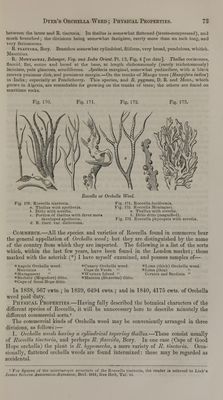
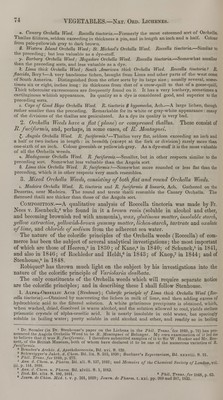
![4. Test of the Colorific Property of Lichens.—Hellot's test is maceration in a weak solution of ammonia (see Roccella tinctoriu). Another method is by testing an alcoholic tincture of the lichen with a solution of hypo- chlorite of lime. If the lichen possess any colorific power, a fugitive red colour is produced. Dr. Stenhouse1 proposes to estimate the quantity of colorific matter in lichens by means of a solution of hypochlorite of lime. Any convenient quantity of the lichen (say one hundred grains) may be cut into very small pieces, and then macerated with milk of lime till all the coloring principle is extracted. Three or four macerations are quite sufficient for this purpose, if the lichen has been sufficiently comminuted. The clear liquors should he filtered and mixed together. A solution of bleaching powder of known strength should then be poured into the litne solution from a graduated alkalimeter. The moment the bleaching liquor comes in con- tact with the lime solution of the lichen, a blood red colour is produced, which disappears in a minute or two, and the liquid has only a deep yellow colour. A new quantity of the bleach- ing liquid should then be poured into the lime solution, and the mixture carefully stirred. This operation should be repeated so long as the addition of the hypochlorite of lime causes the production of the red colour; for this shows that the lime solution stiil contains unoxidized colorific principle. Towards the end of the process, the bleaching solution should be added by only a few drops at a time, the mixture being carefully stirred between each addition. We have only to note how many measures of the bleaching liquor have been required to de- stroy the colouring matter in the solution, to determine the amount of the colorific principle it contained. The following are the results of trials with the same test liquors upon four varie- ties of lichen:— Measures. Angola lichen required 200 = 1.00 American lichen 120 = 0.('0 Cape lichen 035= 0.17 Lecanora tarlarea, from Germany near Giessen 025 = 0 12 The amount of colorific principle in a lichen may also be directly determined by extracting the lichen with milk of lime, by precipitating by means of acetic acid, collecting the precipitate on a weighed filter, drying it at the ordinary temperature, and then weiidiing it. 5. Mode of Extracting the Colorific Principles for Transport.—Dr. Stenhouse sug- gests the following method: cut the lichens into small pieces, macerate them in wooden vats with milk of lime, and saturate the solution either with muriatic or acetic acid. The gelatinous precipitate is then to be collected on cloths, and dried by a gentle heat. In this way almost the whole colorific matter can be easily extracted, and the dried extract transported at a small expense from the most distant inland localities, such as the Andes or Himalayas. Dr. Stenhouse has kindly furnished me with the following table of the lichens, and their colorific principles and coloured products:— Commercial names. S. American Orchella-weed . Cape Orchella-weed Angola Orchella-weed .... Perelle Moss (Lecanora pa- rella) Tartareous Moss (L. tartarea) Pustulatous Moss (Gyrophora pvstulata) Ragged hoary Lichen (Ever- nin prunastri) Usnea (JloriiJa, plicala, and liirla, &c.) Rein-deer Moss (Cladonia rangi/erina) Ramalina (fastigiata) [cali- caris] Locality. Lima, &c. Cape of G. Hope Angola, Africa Switzer- land Norway Norway Scotland Germany COLORIFIC PRINCIPLES. Alpha Or- sellic acid Beta Orsel- lic acid Erythric acid Leeanoric acid Gyrophoric acid Ditto Evernicacid Usnic acid Ditto Ditto C»H0's+HO C3<H>0-f-HO CMH10O9-fHO CI8H809 rjaBQISQIi Ditto C«H»Ol3-f-HO C38Hn0'« Ditto Ditto COLOURING PRINCIPLES. Names. Formula Orceine Ditto Ditto Ditto Ditto Ditto C'WNO Ditto Ditto Ditto Ditto Ditto AUTHORITY. Stenhouse. Stenhouse. Stenhouse. Schunck. Stenhouse. Stenhouse. Stenhouse. Rochleder and Heldt. Rochleder and Heldt. Rochleder and Heldt. 1 Phil. Trans, for 1818.](https://iiif.wellcomecollection.org/image/b21146846_0069.jp2/full/800%2C/0/default.jpg)
 No text description is available for this image
 No text description is available for this image
 No text description is available for this image