The elements of materia medica and therapeutics (Volume 2).
- Jonathan Pereira
- Date:
- 1852-1854
Licence: Public Domain Mark
Credit: The elements of materia medica and therapeutics (Volume 2). Source: Wellcome Collection.
Provider: This material has been provided by the National Library of Medicine (U.S.), through the Medical Heritage Library. The original may be consulted at the National Library of Medicine (U.S.)
87/1226
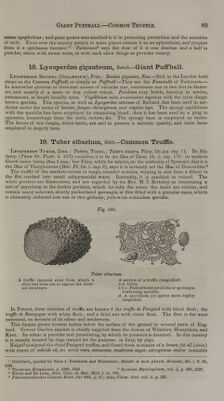
![samus apoplecticus ; and great power was ascribed to it in promoting parturition and the secretion of milk. Even now the country people in some places esteem it as an aphrodisiac, and prepare from it a spirituous tincture.'1 Parkinson2 says the dose of it is one drachm and a half in powder, taken with sweet wine, or with such other things as provoke venery. 18. Lycoperdon giganteum, Batsch.—Giant Puffball. Lycopeiidow Bovista (Gjgantetjm), Fries; BovUta gigantea, Nees.—Sold in the London herb shops as the Common Puffball, or simply as Puffball.—They are the Fusseballs of Parkinson.— In somewhat globular or obconical masses of variable size, sometimes one or two feet in diame- ter, and usually of a more or less yellow colour. Peridium very brittle, bursting in areola?, evanescent, at lenyth broadly open. Capillitium rare, evanescent together with the olive dingy- brown sporidia. This species, as well as Lycoperdon calatum of Bulliard, has been used in me- dicine under the name of bovista, fungus chirurgorum, and crepitus lupi. The spongy capillitium with the sporidia has been employed for staunching blood: thus it has been used as a plug in epistaxis, hemorrhage from the teeth, rectum, &c. The spongy base is employed as tinder. The fumes of this fungus, when burnt, are said to possess a narcotic quality, and have been employed to stupefy bees. 19. Tuber cibarium, Sibth.—Common Truffle. Lycopeiidon Tuber, Linn.; Tubera, Tourn.; Tubera sincera, Pliny, lib. xix. cap. 11. Dr. Sib- thorp (Flora Gr. Prodr. ii. 352) considers it to be the vhov of Diosc. lib. ii. cap. 175: its modern Greek name being 6Jvoc >j ixvcc : but Fries, while lie admits, on the authority of Sprengel, that it is the i!Jw of Theophrastus (Hist. PI. lib. i. cap. 9), says it is certainly not the I'Jvov of Dioscorides.3 The truffle of the markets occurs in rough, rounded nodules, varying in size from a filbert to the fist, cracked into small subpyramidal warts. Internally, it is marbled or veined. The white portions are filamentous, and are regarded by the Rev. M. J. Berkeley as constituting a sort of mycelium to the darker portions, which he calls the veins: the latter are cellular, and contain many subovate, shortly pedicellated sporangia,ai first filled with a granular mass, which is ultimately collected into one or two globular, yellowish echinulate sporidia. Fig. 186. Tuber cibarium. A truffle (natural size) from which a slice has been cut to expose the inter- nal structure. A section of a truffle (magnified). a a. Cells. b b c. Pedicellated peridiola or sporangia containing sporidia. d. A sporidium (or spore) more highly magnified. In France, three varieties of truffle are known :4 the truffle de Perigord with black flesh; the truffle de Bourgogne with white flesh; and a third sort with violet flesh. The first is the most esteemed, on account of its odour and tenderness. This fungus grows several inches below the surface of the ground in several parts of Eng- land. Covent Garden market is chiefly supplied from the downs of Wiltshire, Hampshire, and Kent. Its odour is peculiar and penetrating, by which its presence is detected. In this country it is usually hunted by dogs trained for the purpose: in Italy, by pigs. Riegel8 analyzed the dried Perigord truffles, and found them to consist of a brown fat oil (olein) with traces of volatile oil, an acrid resin, osmazome, mushroom sugar, nitrogenous matter insoluble 1 Gleditsch, quoted by Nees v. Esenbeck and Ebermaier, Handb. d. med. pharm. Botanik, Bd. i. S. 28, 1832. 5 Theatrum Botanicum, p. 1320, 1640. 3 Systema Mycologicum, vol. ii. p. 290, 1822. 4 Merat and ])»■ I.ens, Dirt. Unir. de Mat. Mid. t. vi. 7S3. * Pharmaceutisches Central-Bla.lt fur 1844, p. 17; also, Chem. Gaz. vol. ii. p. 137.](https://iiif.wellcomecollection.org/image/b21146846_0087.jp2/full/800%2C/0/default.jpg)
 No text description is available for this image
 No text description is available for this image
 No text description is available for this image