The elements of materia medica and therapeutics (Volume 2).
- Jonathan Pereira
- Date:
- 1852-1854
Licence: Public Domain Mark
Credit: The elements of materia medica and therapeutics (Volume 2). Source: Wellcome Collection.
Provider: This material has been provided by the National Library of Medicine (U.S.), through the Medical Heritage Library. The original may be consulted at the National Library of Medicine (U.S.)
94/1226
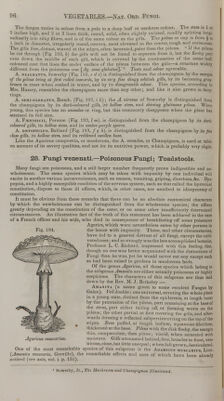
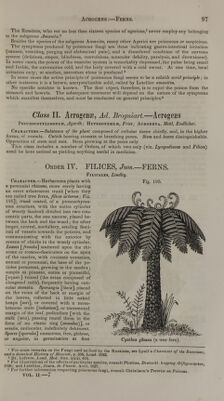
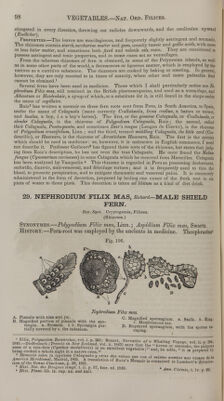
![The fungus varies in colour from a pale to a deep buff or nankeen colour. Tlie stem is 1 or 2 inches bigh, and 2 or 3 lines thick, round, solid, often slightly twisted, readily splitting longi- tudinally into silky fibres, and is of the same colour as the gills. The pileus or cap is from $ to 1 inch in diameter, irregularly round,convex, most elevated in the centre,tongh and coriaceous. The gills free, distant, waved at the edges, often lacerated, paler than the pileus. If the pileui be cut through (Fig 193, 6) the gills will not be found to separate from it, but the fleshy part runs down the middle of each gill, which is covered by the continuation of the same buff- coloured coat that lines the under surface of the pileus between the gills—a structure widely different from the poisonous one [Ag. semi globatus].1 Taste and odour agreeable. A. dkalbattjs, Sowerby (Fig. 193, c d e) is distinguished from the champignon by the margin of the pileus being at first rolled inwards, by its very fine dingy whitish gills, by its becoming gray- brown in zones when soaked in water, and by its disagreeable odour. This species, according to Mrs. Hussey, resembles the champignon more than any other; and like it also grows in fairy- rings. A. skmi-glohatus, Batsch. (Fig. 193, i k) ; the A. virosus of Sowerby is distinguished from the champignon by its dark-coloured gills, its holloiv stem, and shining glutinous pileus. When young, this species has an annulus or ring, but this commonly disappears when the plant has attained its full size. A. Fjenisecii, Persoon (Fig. 193, I m), is distinguished from the champignon by its dark- coloured gills, its hollow stem, and its umber purple spores. A. BHTOPHiLrs, Bulliard (Fig. 193, f g h). is distinguished from the champignon by ns fine close gills, its hollow stem, and its reddened swollen base. Like the Agaricus campestris, or mushroom, the A. oreades, or Champignon, is used at table on account of its savory qualities, and not lor its nutritive power, which is probably vpry slight. 28. Fungi venenati.—Poisonous Fungi; Toadstools. Many fungi are poisonous, and a still larger number frequently prove indigestible and un- wholesome. The same species which may be taken with impunity by one individual will excite in another various inconveniences, such as nausea, vomiting, griping, diarrhcea,&c. Dys- pepsia, and a highly susceptible condition of the nervous system, such as that called the hysterical constitution, dispose to those ill effects, which, in other cases, are ascribed to idiosyncrasy of constitution. It must be obvious from these remarks that there can be no absolute anatomical characters by which the unwholesome can be distinguished from the wholesome species; the effects greatly depending on the constitution of the eater, or on some other insufficiently determined circumstances. An illustrative fact of the truth of this statement has been adduced in the case of a French officer and his wife, who died in consequence of breakfasting off some poisonous Agarics, which were nevertheless eaten by other persons in the house with impunity. These, and other circumstances, have led to a general distrust of all fungi, except the culti- vated ones; and so strongly was the late accomplished botanist, Professor L. C. Richard, impressed with this feeling, that, though no one was better acquainted with the distinctions of Fungi than he was, yet he would never eat any except such as had been raised in gardens in mushroom beds. Of the genus Agaricus, all those species which belong to the subgenus Amanita are either actually poisonous or highly suspicious. The characters of this subgenus are thus laid down by the Rev. M. J. Berkeley :— Amanita (a name given to some esculent Fungus by Galen). Veil double: one universal, covering the whole plant in a young state, distinct from the epidermis, at length burst by the protrusion of the pileus, part remaining at the base of the stem, part either falling off, or forming worts on the pileus; the other partial, at first covering the gills, and after- wards forming a reflected subpersistentring on the topof the stipes. Stem puffed, at length hollow, s.juamoso fibrillose, thickened at the base. Pileus with the disk fleshy, the margin thin, campanulate, then plane; viscid, when saturated with moisture. Gills attenuated behind, free, broader in front, ven- tricose,close,but little unequal; when full-grown,denticulated. One of the most remarkable species of this subgenus is the Agaricus muscarics Linn. (Amanita muscaria, Greville), the remarkable effects and uses of which have been already noticed (see ante, vol. i. p. 152). Agaricus muscanus. 1 Sowerby, Jr., The Mushroom and Champignon Illustrated.](https://iiif.wellcomecollection.org/image/b21146846_0094.jp2/full/800%2C/0/default.jpg)
 No text description is available for this image
 No text description is available for this image
 No text description is available for this image