Chrestien Wechel and Vesalius : twelve unique medical broadsides from the sixteenth century / by Sten G. Lindberg.
- Sten G. Lindberg
- Date:
- 1954
Licence: In copyright
Credit: Chrestien Wechel and Vesalius : twelve unique medical broadsides from the sixteenth century / by Sten G. Lindberg. Source: Wellcome Collection.
16/30 page 62
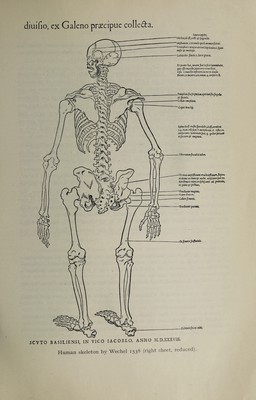
![cated to the then Dean of the Medical Faculty, Jean Tagault.5 In 1536 he published a manual of anatomy, Institutiones anatomicae, the first of its kind. Vesalius had collaborated in the writing of this manual, as Gunther acknowl¬ edges in the preface, and as Vesalius himself mentions in several places.6 7 Vesa¬ lius published an edition of the book in Venice in the same year as the Tabulae appeared, 1538. There are many terms in the latter which Vesalius had taken from his teacher in Paris, and it is not surprising that this Parisian usage should also be found in Wechel’s Osteotome.11 It has likewise terms that one recognises from the writings of other Parisian physicians such as Jacobus Sylvius (Du Bois), another of Vesalius’s teachers, and Charles Estienne—though their books appeared after Vesalius’s Tabulae.8 In view of the possibility that Vesalius might have used the Osteotome for his Tabulae, it is interesting to note that certain terms are more correct in Wechel’s version than in Vesalius’s, as well as that the Osteotome, for all its unwieldiness, gives a better drawing of the sternum than Calcar could achieve.9 * The philological exactitude discernible in the details of the pirated Paris edition of the Tabulae is thus noticeable in the Osteotome too. It is also in evidence in the three other skeleton plates among the broadsides of the Royal Library in Stockholm. Like the five sheets already mentioned, these were also printed by Chrestien Wechel. They have the text from the last three of the Tabulae together with woodcuts which are known from publications in 1541 of the Strassburg plagiarist Walter Ryff. Cushing gives full particulars of where these plates occur in the various editions issued by Ryff.1 In addition, he shows 5 E. Turner, Jean Guinter d’Andernach (1505—1574) (Gazette hebdomadaire de medecine et de chirurgie 28 (1881), 425—434, 505—516). Regarding G’s work, see- Maittaire 434—437 and 5I5—5I9- 6 Roth 66—71; Cushing 44 et seq. 7 As given in Singer & Rabin: radius 145, brachiale 150, metakarpion 154, pecten 155, patella 162, chalcoidea (a more correct transcription in the Osteotome) 184, ischion 251, lithoide 298, omoplata 302 (300). 8 ulna 141, os balistae 170, metaphreni 231, lapidosa 296. 9 Rostro corui instead of rostrum porcinum 115, chalcoidea instead of kalkoide 184, obelaea instead of oboliaia 284, os femoris instead of faemur 338. 1 Anatomi. Strassburg: B. Beck 1541 (fol. Aib. C2b, Csb). [Tabulae decern in German] Ibidem 1541 (fol. D right, E left, E right). Omnium humani corporis partium descriptio seu ut vocant Anatomia. Ibidem 1541 (as the preceding). Ditto, Paris: H. Gourmont 1545 (as the preceding). Anatomica omnium humani corporis. Paris: C. Wechel 1543. (D2a, D3a, D4a). Description anatomique. (French edition of Anatomica) Ibidem 1543 (as the preceding).](https://iiif.wellcomecollection.org/image/b30634003_0016.jp2/full/800%2C/0/default.jpg)