Chrestien Wechel and Vesalius : twelve unique medical broadsides from the sixteenth century / by Sten G. Lindberg.
- Sten G. Lindberg
- Date:
- 1954
Licence: In copyright
Credit: Chrestien Wechel and Vesalius : twelve unique medical broadsides from the sixteenth century / by Sten G. Lindberg. Source: Wellcome Collection.
7/30 page 53
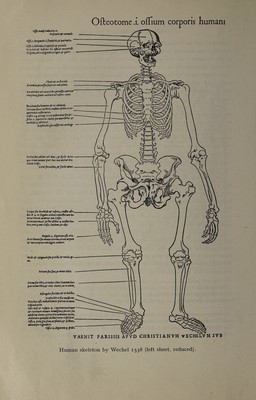
![Oporinus, and which the latter printed in the introduction to the Fabrica, 1543, Vesalius says1: But these privileges are often not worth the paper they cover, as I know but too well, from what happened to my Anatomical Tables published at Venice three years ago, the value of the decrees of sovereigns issued to printers and booksellers who swarm everywhere and have marred my works in putting them forth under pompous titles. In the edition of Augsburg the letter which I have written to Narcissus Ver- tunus, that model of physicians of our time, and first physician to the Emperor and king of Naples, has been suppressed and replaced by the preface of a German babbler who, unworthily decrying Avicenna and the Arabic authors, ranks me with the abridged Galens and, to cheat the buyer, pretends that I have put into six tables what in Galen fills thirty books. Moreover, he affirms that in his German translation he has used Greek and Latin terms, whereas he has not only suppressed these but has likewise omitted all that he could not translate and nearly all that gave value to my Tables; to say nothing of his wretched copies of the Venetian prints. He who has pirated them at Coin has done still worse than his fellow of Augsburg; and although some anonymous scribe has written in praise of the printer that his plates are better than mine, they are in truth merely clumsy copies of rough sketches of my own which I had communicated to some of my friends during the progress of the work. At Paris they have copied the three first plates very well (added in the 1555 ed.: “in the Latin edition and in the French edition”)2, but the others they have omitted, perhaps because they were difficult to engrave, though it was these first three which students could have best dispensed with. Worst of all, so far as science is concerned, at Strasburg, another plagiarist, whom Fuchs greatly blamed, thought fit to contract the size of the plates, which can hardly be too large, to daub them with ugly colouring, and to surround them with a text borrowed from that of the Augsburg edition, but put forth as his own. Envying this man’s fame, another is publishing a book, compiled from all quarters and illustrated with prints taken from books printed at Marburg and Frank¬ fort. Indeed I would gladly put up with and even welcome [the cost entailed on me by] the divine and happy Italian wits [whose works] deserve an appreciation from the doctors in Germany different from that which they have received from those who know them only as reproduced by the miserable slaves of sordid printers who, seizing upon any writing from which a little profit can be wrung, abridge it without discernment, or alter it, or merely copy it, and publish it under their own names as something new, and as if it were not protected by any privilege. Choulant succeeded in identifying most of these pirated versions. It is now agreed that the Augsburg version was printed by Jobst de Necker in June, 1 In Stirling and Maxwell’s rendering, cited by Cushing, 16 et seq. Cf. Choulant and Frank, 185 et seq. 2 As remarked by A. F. Didot, Essai typographique sur l’histoire de la gravure sur bois, Paris 1863, column 94.](https://iiif.wellcomecollection.org/image/b30634003_0007.jp2/full/800%2C/0/default.jpg)

 No text description is available for this image
 No text description is available for this image
 No text description is available for this image