The preparation and some properties of purified diphtheria toxoid / by Arthur Frederick Watson and Elsie Langstaff.
- Watson, A. F.
- Date:
- [1926?]
Licence: In copyright
Credit: The preparation and some properties of purified diphtheria toxoid / by Arthur Frederick Watson and Elsie Langstaff. Source: Wellcome Collection.
15/20 page 775
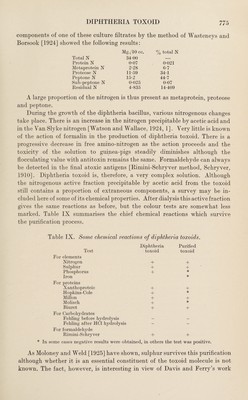
![components of one of these culture filtrates by the method of Wasteneys and Borsook [1924] showed the following results: Total N Mg./lO cc. 3400 % total N Protein N 0-07 0-021 Metaprotein N 2-28 6-7 Proteose N 11-59 34-1 Peptone N 15-2 44-7 Sub-peptone N 0-025 0-07 Residual N 4-835 14-409 A large proportion of the nitrogen is thus present as metaprotein, proteose and peptone. During the growth of the diphtheria bacillus, various nitrogenous changes take place. There is an increase in the nitrogen precipitable by acetic acid and in the Van Slyke nitrogen [Watson and Wallace, 1924, 1]. Very little is known of the action of formalin in the production of diphtheria toxoid. There is a progressive decrease in free amino-nitrogen as the action proceeds and the toxicity of the solution to guinea-pigs steadily diminishes although the flocculating value with antitoxin remains the same. Formaldehyde can always be detected in the final atoxic antigens [Rimini-Schryver method, Schryver, 1910]. Diphtheria toxoid is, therefore, a very complex solution. Although the nitrogenous active fraction precipitable by acetic acid from the toxoid still contains a proportion of extraneous components, a survey may be in¬ cluded here of some of its chemical properties. After dialysis this active fraction gives the same reactions as before, but the colour tests are somewhat less marked. Table IX summarises the chief chemical reactions which survive the purification process. Table IX. Some chemical reactions of diphtheria toxoids. Test Diphtheria toxoid Purified toxoid For elements Nitrogen + + Sulphur + + Phosphorus + * Iron * For proteins Xanthoproteic + + Hopkins-Cole + * Millon + + Molisch + * Biuret + + For Carbohydrates Fehling before hydrolysis — — Fehling after HC1 hydrolysis — — For formaldehyde Rimini-Schryver + -1- * In some cases negative results were obtained, in others the test was positive. As Moloney and Weld [1925] have shown, sulphur survives this purification although whether it is an essential constituent of the toxoid molecule is not known. The fact, however, is interesting in view of Davis and Ferry’s work](https://iiif.wellcomecollection.org/image/b30625385_0015.jp2/full/800%2C/0/default.jpg)