The preparation and some properties of purified diphtheria toxoid / by Arthur Frederick Watson and Elsie Langstaff.
- Watson, A. F.
- Date:
- [1926?]
Licence: In copyright
Credit: The preparation and some properties of purified diphtheria toxoid / by Arthur Frederick Watson and Elsie Langstaff. Source: Wellcome Collection.
16/20 page 776
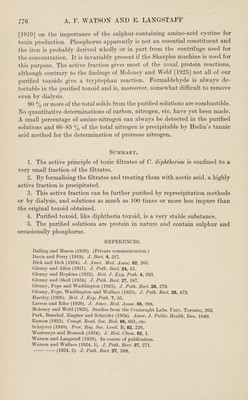
![[1919] on the importance of the sulphur-containing amino-acid cystine for toxin production. Phosphorus apparently is not an essential constituent and the iron is probably derived wholly or in part from the centrifuge used for the concentration. It is invariably present if the Sharpies machine is used for this purpose. The active fraction gives most of the usual protein reactions, although contrary to the findings of Moloney and Weld [1925] not all of our purified toxoids give a tryptophan reaction. Formaldehyde is always de¬ tectable in the purified toxoid and is, moreover, somewhat difficult to remove even by dialysis. 90 % or more of the total solids from the purified solutions are combustible. No quantitative determinations of carbon, nitrogen, etc. have yet been made. A small percentage of amino-nitrogen can always be detected in the purified solutions and 60-85 % of the total nitrogen is precipitable by Hedin’s tannic acid method for the determination of proteose nitrogen. Summary. 1. The active principle of toxic filtrates of C. di'phtheriae is confined to a very small fraction of the filtrates. 2. By formalising the filtrates and treating them with acetic acid, a highly active fraction is precipitated. 3. This active fraction can be further purified by reprecipitation methods or by dialysis, and solutions as much as 100 times or more less impure than the original toxoid obtained. 4. Purified toxoid, like diphtheria toxoid, is a very stable substance. 5. The purified solutions are protein in nature and contain sulphur and occasionally phosphorus. REFERENCES. Dalling and Mason (1926). (Private communication.) Davis and Ferry (1919). J. Bad. 4, 217. Dick and Dick (1924). J. Amer. Med. Assoc. 82, 265. Glenny and Allen (1921). J. Path. Bad. 24, 61. Glenny and Hopkins (1923). Brit. J. Exp. Path. 4, 283. Glenny and Okell (1924). J. Path. Bad. 27, 187. Glenny, Pope and Waddington (1925). J. Path. Bad. 28, 279. Glenny, Pope, Waddington and Wallace (1925). J. Path. Bad. 28, 473. Hartley (1926). Brit. J. Exp. Path. 7, 55. Larson and Eder (1926). J. Amer. Med. Assoc. 86, 998. Moloney and Weld (1925). Studies from the Connaught Labs. Univ. Toronto, 263. Park, Banzhaf, Zingher and Schroder (1924). Amer. J. Public Health, Dec. 1049. Ramon (1922). Compt. Rend. Soc. Biol. 86, 661, etc. Schryver (1910). Proc. Roy. Soc. Bond. B, 82, 226. Wasteneys and Borsook (1924). J. Biol. Chem. 62, 1. Watson and Langstaff (1926). In course of publication. Watson and Wallace (1924, 1). J. Path. Bad. 27, 271. -(1924, 2). /. Path. Bad. 27, 289.](https://iiif.wellcomecollection.org/image/b30625385_0016.jp2/full/800%2C/0/default.jpg)