The red notebook of Charles Darwin / edited, with an introduction and notes by Sandra Herbert.
- Charles Darwin
- Date:
- 1980
Licence: Attribution-NonCommercial-NoDerivatives 4.0 International (CC BY-NC-ND 4.0)
Credit: The red notebook of Charles Darwin / edited, with an introduction and notes by Sandra Herbert. Source: Wellcome Collection.
102/184 (page 88)
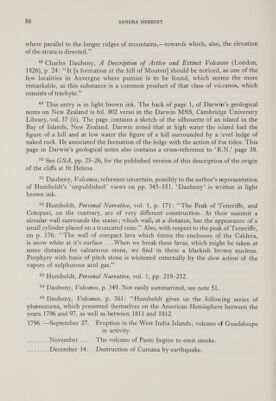
![88 SANDRA HERBERT where parallel to the longer ridges of mountains,—towards which, also, the elevation of the strata is directed. Charles Daubeny, A Description of Active and Extinct Volcanos (London, 1826), p. 24: It [a formation at the hill of Mouton] should be noticed, as one of the few localities in Auvergne where pumice is to be found, which seems the more remarkable, as this substance is a common product of that class of volcanos, which consists of trachyte. This entry is in light brown ink. The back of page 1, of Darwin's geological notes on New Zealand is fol. 802 verso in the Darwin MSS, Cambridge University Library, vol. 37 (ii). The page contains a sketch of the silhouette of an island in the Bay of Islands, New Zealand. Darwin noted that at high water the island had the figure of a hill and at low water the figure of a hill surrounded by a level ledge of naked rock. He associated the formation of the ledge with the action of the tides. This page in Darwin's geological notes also contains a cross-reference to 'R.N.' page 38. See GSA, pp. 25-26, for the published version of this description of the origin of the cliffs at St Helena. Daubeny, Volcanos, reference uncertain, possibly to the author's representation of Humboldt's 'unpublished' views on pp. 345-351. 'Daubeny' is written in light brown ink. Humboldt, Personal Narrative, vol. 1, p. 171: The Peak of Teneriffe, and Cotopaxi, on the contrary, are of very different construction. At their summit a circular wall surrounds the crater; which wall, at a distance, has the appearance of a small cylinder placed on a truncated cone. Also, with respect to the peak of Teneriffe, on p. 176: The wall of compact lava which forms the enclosure of the Caldera, is snow white at it's surface. . . .When we break these lavas, which might be taken at some distance for calcareous stone, we find in them a blackish brown nucleus. Porphyry with basis of pitch stone is whitened externally by the slow action of the vapors of sulphurous acid gas. Humboldt, Personal Narrative, vol. 1, pp. 219-232. Daubeny, Volcanos, p. 349. Not easily summarized, see note 51. Daubeny, Volcanos, p. 361: Humboldt gives us the following series of phaenomena, which presented themselves on the American Hemisphere between the years 1796 and 97, as well as between 1811 and 1812. 1796.—September 27. Eruption in the West India Islands; volcano of Guadaloupe in activity. November ... The volcano of Pasto begins to emit smoke. December 14. Destruction of Cumana by earthquake.](https://iiif.wellcomecollection.org/image/b18032783_0103.JP2/full/800%2C/0/default.jpg)