The red notebook of Charles Darwin / edited, with an introduction and notes by Sandra Herbert.
- Charles Darwin
- Date:
- 1980
Licence: Attribution-NonCommercial-NoDerivatives 4.0 International (CC BY-NC-ND 4.0)
Credit: The red notebook of Charles Darwin / edited, with an introduction and notes by Sandra Herbert. Source: Wellcome Collection.
108/184 (page 94)
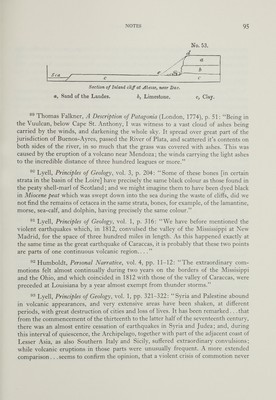
![94 SANDRA HERBERT vitreous and always finer grained. A thin parting band, approaching in its character to pitchstone, occasionally intervenes on the contact of the vertical dike and intersected beds. M. Necker mentions one of these at the place called Primo Monte, in the Atrio del Cavallo; I saw three or four others in different parts of the great escarpment. William F. W. Owen, Narrative of Voyages to. . .Africa, Arabia, and Mada¬ gascar (London, 1833), vol. 2, pp. 274-275: [at Benguela]. . .the elephants were likewise common, but at present are scarce. A number of these animals had some time since entered the town in a body, to possess themselves of the wells, not being able to procure any water in the country. The inhabitants mustered, when a desperate conflict ensued, which terminated in the ultimate discomfiture of the invaders, but not until they had killed one man and wounded several others. Lyell, Principles of Geology, vol. 2, p. 189: Thousands of carcasses of terres¬ trial animals are floated down every century into the sea, and, together with forests of drift-timber, are imbedded in subaqueous deposits, where their elements are im¬ prisoned in solid strata. . .. Also p. 247: . . .we see the putrid carcasses of dogs and cats, even in rivers, floating with considerable weights attached to them.... Claude Gay, 'Aperçu sur les recherches d'histoire naturelle faites dans l'Amérique du sud, et principalement dans le Chili, pendent les années 1830 et 1831 ', Annales des sciences naturelles, vol. 28 (1833), p. 371: Ces contrées [Rio de Janeiro, Monte Video, Buenos Aires] m'offrirent aussi une assez belle collection d'insectes et plusieurs coquilles fluviátiles et marines, telles que des Mytilus, des Solens, des Ampullaires, etc., qui offraient ce phénomène digne de remarque, de vivre pêle-mêle dans les eaux simplement saumâtres. See Jii, p. 24. De La Beche, Geological Manual, p. 73: The Chesil Bank, connecting the Isle of Portland with the main land, is about sixteen miles long, and. . .the pebbles increase in size from west to east. . .The sea separates the Chesil Bank from the land for about half its length, so that, for about eight miles, it forms a shingle ridge in the sea. The effects of the waves, however, on either side are very unequal; on the western side the propelling and piling influence is considerable, while on the eastern, or that part between the bank and the main land, it is of trifling importance. Capt. Robert Fitzroy (note 27). Lyell, Principles of Geology, vol. 3, pp. 210-211: The situation of this cliff [at Dax, France], is interesting, as marking one of the pauses which intervened between the successive movements of elevation whereby the marine tertiary strata of this country were upheaved to their present height, a pause which allowed time for the sea to advance and strip off the upper beds a,b, from the denuded clay c.](https://iiif.wellcomecollection.org/image/b18032783_0109.JP2/full/800%2C/0/default.jpg)