The red notebook of Charles Darwin / edited, with an introduction and notes by Sandra Herbert.
- Charles Darwin
- Date:
- 1980
Licence: Attribution-NonCommercial-NoDerivatives 4.0 International (CC BY-NC-ND 4.0)
Credit: The red notebook of Charles Darwin / edited, with an introduction and notes by Sandra Herbert. Source: Wellcome Collection.
114/184 (page 100)
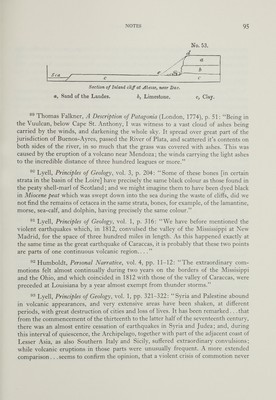
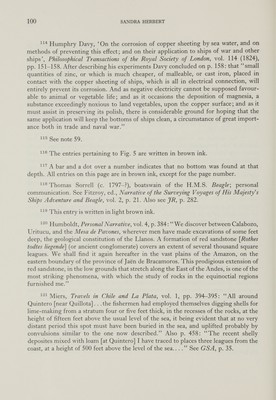
![100 SANDRA HERBERT Humphry Davy, 'On the corrosion of copper sheeting by sea water, and on methods of preventing this effect; and on their apphcation to ships of war and other ships', Philosophical Transactions of the Royal Society of London, vol. 114 (1824), pp. 151-158. After describing his experiments Davy concluded on p. 158: that small quantities of zinc, or which is much cheaper, of malleable, or cast iron, placed in contact with the copper sheeting of ships, which is all in electrical connection, will entirely prevent its corrosion. And as negative electricity cannot be supposed favour¬ able to animal or vegetable life; and as it occasions the deposition of magnesia, a substance exceedingly noxious to land vegetables, upon the copper surface ; and as it must assist in preserving its polish, there is considerable ground for hoping that the same application will keep the bottoms of ships clean, a circumstance of great import¬ ance both in trade and naval war. See note 59. The entries pertaining to Fig. 5 are written in brown ink. A bar and a dot over a number indicates that no bottom was found at that depth. All entries on this page are in brown ink, except for the page number. Thomas Sorrell (c. 1797-?), boatswain of the H.M.S. Beagle] personal communication. See Fitzroy, ed.. Narrative of the Surveying Voyages of His Majesty^s Ships Adventure and Beagle, vol. 2, p. 21. Also see JR, p. 282. This entry is written in light brown ink. Humboldt, Personal Narrative, vol. 4, p. 384: We discover between Calabozo, Uritucu, and the Mesa de Pavones, wherever men have made excavations of some feet deep, the geological constitution of the Llanos. A formation of red sandstone [Rothes todtes liegende^ (or ancient conglomerate) covers an extent of several thousand square leagues. We shall find it again hereafter in the vast plains of the Amazon, on the eastern boundary of the province of Jaën de Bracamoros. This prodigious extension of red sandstone, in the low grounds that stretch along the East of the Andes, is one of the most striking phenomena, with which the study of rocks in the equinoctial regions furnished me. Miers, Travels in Chile and La Plata, vol. 1, pp. 394-395: All around Quintero [near Quillota]. . . the fishermen had employed themselves digging shells for lime-making from a stratum four or five feet thick, in the recesses of the rocks, at the height of fifteen feet above the usual level of the sea, it being evident that at no very distant period this spot must have been buried in the sea, and uplifted probably by convulsions similar to the one now described. Also p. 458: The recent shelly deposites mixed with loam [at Quintero] I have traced to places three leagues from the coast, at a height of 500 feet above the level of the sea.... See GSA, p. 35.](https://iiif.wellcomecollection.org/image/b18032783_0115.JP2/full/800%2C/0/default.jpg)