Triennial vaccination report of the Province of Assam : with brief explanatory notes.
- Assam
- Date:
- [1920]
Licence: Public Domain Mark
Credit: Triennial vaccination report of the Province of Assam : with brief explanatory notes. Source: Wellcome Collection.
5/28
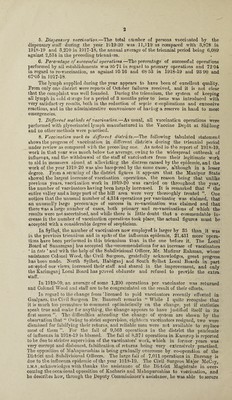
![[Maximum limit of narrative portion ot the report—*8 pages-] TRIENNIAL REPORT ON Vaccination in Assam FOR THE YEARS 191718, 1918-19 and 1919-20. 1. Introductory.—The charge of the Vaccination Department throughout tho triennium from 1917-18 to 1919-20 was held by me. The yearly reports of 1917-18 and 1918-19 contained observations on the more important features of the work of those years, while this report deals more fully with the vaccination work performed during the triennium as a whole. 2. Vaccination agencies.—The average annual number of vaccinators employed during the triennium under review was 353, as compared with 312 in the preceding triennium. In July 1918, a proposal to increase the number of vaccinators enter¬ tained by Local Boards was submitted to the Local Administration, which was calculated on the basis of an annual visit to every village, as it had been^ noticed that outlying villages were often not visited by vaccinators even at intervals of five years or more. It is satisfactory to note that the majority of Local Boards have now accepted these recommendations, with good results, although Sylhet is still 27 short of the necessary number, partly owing to the refusal of Karimganj Local Board to increase its staff. Licensed vaccinators are no longer employed in any district, Goalpara, which was the last to retain this system having abandoned it for the work of 1919-20. The average number of operations performed by a vaccinator during the triennium was 938 against 982 of the previous triennial period, the decrease being largely due to the very small amount of vaccination done during the influenza epidemic of 1913- 19. 3. Total number of operations.—The total number of operations performed by all establishments during the triennial period,. 1917-18 to 1919-20, was 1,085,373 as compared with 1,001,076 in the preceding triennium 1911-15 to 1916-17, showing an increase of 81,297 operations, to which Manipur State contributed 80,817, although excluding Manipur State, there was not much increase. The number of operations performed during the year 1919-20 was 441,866 with 328,692 primary and 113,174 re-vaccinations, against 289,184, 237,005 and 52,179, respectively, in 1918-19 and 354,323, 291,281 and 63,042, respectively, in 1917-18. The prevalence of influenza in 1918-19 interfered greatly with vaccination work and had it not been for the increase of 1919-20, the out-turn of the triennium under review would have been much lower than that of the preceding one. The number of persons successfully vaccinated during the year 1919-20 was at the rate of 52 97 per 1,000 of population as compared with 36‘31 in 1918-19 and 43’74 in 1917-18. The corresponding rate during the triennial period ending 1919-20 was 44’3t as against 43’82 for the preceding period. 4. Deaths from small pox.—The ratio of mortality from small-pox per 1,000 of population in 1919 was ‘20 as compared with 31 per mille in 1918 and ’59 per mille in 1917. The highest ratio of’66 per mille was reported from Goalpara, the next highest, '58 per mille, being reported from Sibsagar. The provincial ratio for the year was lower than that of any of the preceding ten years.](https://iiif.wellcomecollection.org/image/b31495849_0005.jp2/full/800%2C/0/default.jpg)