Licence: In copyright
Credit: A manual of general pathology for students / by Sidney Martin. Source: Wellcome Collection.
Provider: This material has been provided by the Royal College of Physicians of Edinburgh. The original may be consulted at the Royal College of Physicians of Edinburgh.
478/534 (page 452)
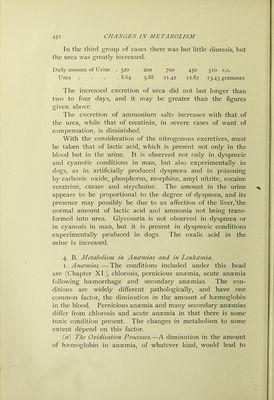
![In the third group of cases there was but little diuresis, but the urea was greatly increased. Daily amount of Urine . 320 200 700 450 510 c.c. Urea .... 8.64 5.88 21.42 12.82 13.43 grammes The increased excretion of urea did not last longer than two to four days, and it may be greater than the figures given above. The excretion of ammonium salts increases with that of the urea, while that of creatinin, in severe cases of want of compensation, is diminished. With the consideration of the nitrogenous excretives, must be taken that of lactic acid, which is present not only in the blood but in the urine. It is observed not only in dyspnoeic and cyanotic conditions in man, but also experimentally in dogs, as in artificially produced dyspnoea and in poisoning by carbonic oxide, phosphorus, morphine, amyl nitrite, cocaine veratrine, curare and strychnine. The amount in the urine appears to be proportional to the degree of dyspnoea, and its presence may possibly be due to an affection of the liver,'the normal amount of lactic acid and ammonia not being trans- formed into urea. Glycosuria is not ob.served in dyspnoea or in cyanosis in man, but it is present in dyspnceic conditions experimentally produced in dogs. The oxalic acid in the urine is increased. 4. B. ]\Ietnbolis))i in A7uzniias and m Leukceniia. I. AncBuiias. — The conditions included under this head are (Chapter XI.), chlorosis, pernicious anaemia, acute anaemia following haemorrhage and secondary anaemias. The con- ditions are widely different pathologically, and have one common factor, the diminution in the amount of haemoglobin in the blood. Pernicious anaemia and many secondary anaemias differ from chlorosis and acute anaemia in that there is some toxic condition present. The changes in metabolism to some extent depend on this factor. {ak The Oxidisation Pi'ocesses.—A diminution in the amount of haemoglobin in anaemia, of whatever kind, would lead to](https://iiif.wellcomecollection.org/image/b21932268_0490.jp2/full/800%2C/0/default.jpg)