A handbook of medical climatology : Embodying its principles and therapeutic application with scientific data of the chief health resorts of the world / By S. Edwin Solly.
- Solly, S. Edwin (Samuel Edwin), 1845-1906.
- Date:
- 1897
Licence: Public Domain Mark
Credit: A handbook of medical climatology : Embodying its principles and therapeutic application with scientific data of the chief health resorts of the world / By S. Edwin Solly. Source: Wellcome Collection.
Provider: This material has been provided by the Harvey Cushing/John Hay Whitney Medical Library at Yale University, through the Medical Heritage Library. The original may be consulted at the Harvey Cushing/John Hay Whitney Medical Library at Yale University.
27/518 page 25
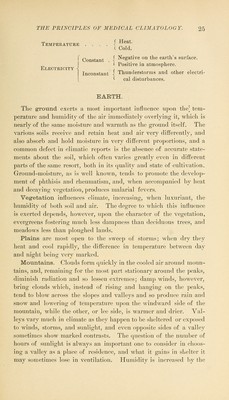
![Temperature . . . . { Heat- 1 Cold. f Constant 1 ^eSatiye on tne earth's surface. J I Positive in atmosphere. Electricity -J , Inconstant ■! Thunderstorms and other electri- <■ cal disturbances. EARTH. The ground exerts a most important influence upon the] tem- perature and humidity of the air immediately overlying it, which is nearly of the same moisture and warmth as the ground itself. The various soils receive and retain heat and air very differently, and also absorb and hold moisture in very different proportions, and a common defect in climatic reports is the absence of accurate state- ments about the soil, which often varies greatly even in different parts of the same resort, both in its quality and state of cultivation. Ground-moisture, as is well known, tends to promote the develop- ment of phthisis and rheumatism, and, when accompanied by heat and decaying vegetation, produces malarial fevers. Vegetation influences climate, increasing, when luxuriant, the humidity of both soil and air. The degree to which this influence is exerted depends, however, upon the character of the vegetation, evergreens fostering much less dampness than deciduous trees, and meadows less than ploughed lands. Plains are most open to the sweep of storms; when dry they heat and cool rapidly, the difference in temperature between day and night being very marked. Mountains. Clouds form quickly in the cooled air around moun- tains, and, remaining for the most part stationary around the peaks, diminish radiation and so lessen extremes; damp winds, however, bring clouds which, instead of rising and hanging on the peaks, tend to blow across the slopes and valleys and so produce rain and snow and lowering of temperature upon the windward side of the mountain, while the other, or lee side, is warmer and drier. Val- leys vary much in climate as they happen to be sheltered or exposed to winds, storms, and sunlight, and even opposite sides of a valley sometimes show marked contrasts. The question of the number of hours of sunlight is always an important one to consider in choos- ing a valley as a place of residence, and what it gains in shelter it may sometimes lose in ventilation. Humidity is increased by the](https://iiif.wellcomecollection.org/image/b21002903_0027.jp2/full/800%2C/0/default.jpg)
 No text description is available for this image
 No text description is available for this image
 No text description is available for this image