Licence: Public Domain Mark
Credit: Qualitative chemical analysis / by C. Remigius Fresenius. Source: Wellcome Collection.
Provider: This material has been provided by the Royal College of Physicians of Edinburgh. The original may be consulted at the Royal College of Physicians of Edinburgh.
105/526 page 81
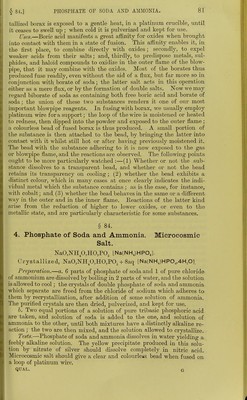
![tallized borax is exposed to a gentle heat, in a platinum crucible, until it ceases to swell up ; when cold it is pulverized and kept for use. Cses.—Boric acid manifests a great affinity for oxides when brought into contact with them in a state of fusion. This affinity enables it, in the fii*st place, to combine directly with oxides; secondly, to expel weaker acids from their salts; and, thirdly, to predispose metals, sul- phides, and haloid compounds to oxidize in the outer flame of the blow- pipe, that it may combine with the oxides. Most of the borates thus produced fuse readily, even without the aid of a flux, but far more so in conjunction with borate of soda; the latter salt acts in this operation either as a mere flux, or by the formation of double salts. Now we may regard biborate of soda as containing both free boric acid and borate of soda; the union of these two substances renders it one of our most important blowpipe reagents. In fusing with borax, we usually employ platinum wire for a support; the loop of the wire is moistened or heated to redness, then dipped into the powder and exposed to the outer flame ; a colourless bead of fused borax is thus produced. A small portion of the substance is then attached to the bead, by bringing the latter into contact with it whilst still hot or after having previously moistened it. The bead with the substance adhering to it is now exposed to the gas or blowpipe flame, and the reactions are observed. The following points ought to be more particulai-ly watched :—(1) Whether or not the sub- stance dissolves to a transparent bead, and whether or not the bead retains its transparency on cooling; (2) whether the bead exhibits a distinct colour, which in many cases at once clearly indicates the indi- vidual metal which the substance contains ; as is the case, for instance, with cobalt; and. (3) whether the bead behaves in the same or a different way in the outer and in the inner flame. Reactions of the latter kind arise from the reduction of higher to lower oxides, or even to the metallic state, and are particularly characteristic for some substances. § 84. 4. Phosphate of Soda and Ammonia. Microcosmic Salt. NaO,NHp,HO,PO, [Na(NH,)HPOJ. Crystallized, NaO,NHp,HO,P05 + 8aq [Na(NH,)HP0„4H,0]. Prejyaration.—a. 6 parts of phosphate of soda and 1 of pure chloride of ammonium are dissolved by boiling in 2 parts of water, and the solution is allowed to cool; the crystals of double phosphate of soda and ammonia which separate are freed from the chloride of sodium which adheres to them by recrystallization, after addition of some solution of ammonia. The purified crystals are then dried, pulverized, and kept for use. h. Two equal portions of a solution of pure tribasic phosphoric acid are taken, and solution of soda is added to the one, and solution of ammonia to the other, until both mixtures have a distinctly alkaline re- action ; the two are then mixed, and the solution allowed to crystallize. Teats.—Phosphate of soda and ammonia dissolves in water yielding a feebly alkaline solution. The yellow precipitate produced in this solu- tion by nitrate of silver should dissolve completely in nitric acid. Microcosmic salt should give a clear and colourless bead when fused on a loop of platinum wire. qUAL. G](https://iiif.wellcomecollection.org/image/b21966953_0105.jp2/full/800%2C/0/default.jpg)